

 Written by
 Model Trains for Beginners: How to Start and Customize Your Layout
Model railroading is a rewarding hobby that combines creativity, craftsmanship, engineering, and storytelling. Whether you want a small shelf display, a realistic freighter line through a mountain pass, or a bustling urban commuter scene, model trains offer endless possibilities. This model railroad beginner guide will walk you through everything you need to know to get started, from choosing a scale to advanced model railroad modding, and practical tips for custom model trains and model train customization.
Why Start Model Trains?

– It’s creative: design landscapes, structures, and scenes.
– It’s technical: learn electronics, wiring, and mechanical skills.
– It’s social: join clubs, online communities, and exhibitions.
– It’s relaxing and absorbing: a hands-on, slow-craft hobby away from screens.
If you’ve searched for “model trains for beginners” or “how to start model trains,” this guide gives a step-by-step path to go from curiosity to a working, customized layout.
Scales and Gauges: Picking the Right Size
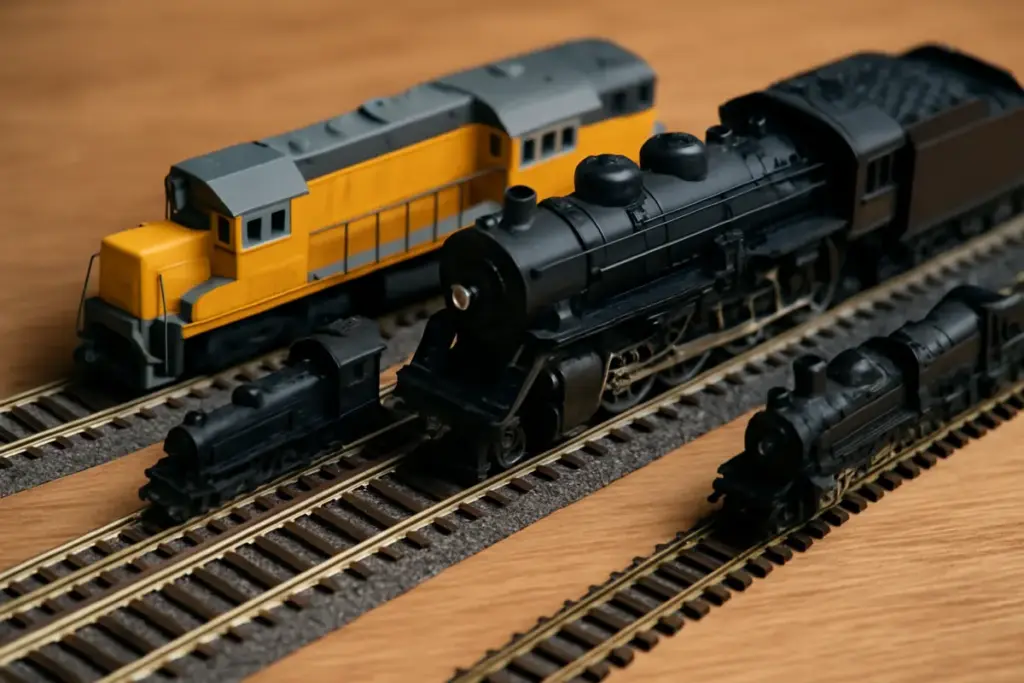
Understanding scale (proportion to real life) and gauge (distance between rails) is the first step.
Common scales for beginners:
– HO (1:87): The most popular scale. Great balance of detail, space requirements, and availability.
– N (1:160): Smaller than HO; good if you have limited space and want longer runs.
– O (1:48) / OO (1:76): Larger-sized options with impressive detail; O scale requires more space.
– Z (1:220): Very small; used for compact or highly detailed yet small layouts.
Choosing scale depends on:
– Space: N or Z if you have limited room; HO for most hobbyists.
– Budget: Larger scales generally cost more per item.
– Availability: HO has the largest market for ready-to-run models and parts.
Example: A 4×8 foot HO layout gives a lot of operational interest; an N-scale 4×8 can host more trackage and scenery.
Starter Sets vs Building from Scratch
Beginners often start with a starter set, which typically includes:
– Locomotive and a few cars
– Track sections for a basic loop
– Power pack and controller
– Simple instructions
Pros:
– Quick to run out of the box
– Affordable
– Great for learning basic track and power
Cons:
– Limited quality and realism
– May not match your desired era or brand
Building from scratch:
– Buy a locomotive and rolling stock separately
– Purchase track (flex track and turnouts), a control system (DC or DCC), and power supply
– Design benchwork, lay track, and build scenery
The starter set is a fine first step. As your interest grows, upgrade components and customize the layout to your tastes.
Choosing a Theme or Era
A theme gives your layout focus and helps with decisions (rolling stock, buildings, colors, and operations).
Popular themes:
– Steam-era branchline (late 1800s–1950s)
– Modern freight yard (1970s–present)
– Commuter/timetable-based passenger line
– Industrial switching (a small yard serving factories)
– Historical re-creation of a real railroad or location
Example: Choose a 1950s U.S. shortline theme and collect USRA-style steam engines, boxcars, and 1:87 structures.
Choosing a period affects:
– Locomotive and car choices
– Structures and vehicles (cars, trucks)
– Signage, roadbed, and ballast colors
Planning Your First Layout
A good plan saves frustration. Start small and iterate.
Steps:
1. Set goals: do you want operations (shunting/switching), scenic realism, or display?
2. Measure space: table, shelf, or dedicated room?
3. Sketch track plans: use online plan tools or graph paper.
4. Decide on staging/hidden yards: extend operations without visible track.
5. Consider accessibility: fascia heights, walkaround space.
Example 4×8 HO beginner plan:
– Continuous loop with a passing siding
– Small yard with 4 tracks for switching
– Industrial spur with one or two industries (e.g., coal dealer, grain elevator)
– A small town scene with a depot and a road crossing
Keep turnouts, crossovers, and passing tracks to enhance operations.
Benchwork and Roadbed
Benchwork is the table or framework that supports your layout.
Options:
– Traditional 2×4 frame with plywood top — sturdy and customizable.
– Pre-made hobby tables or modular benchwork — convenient.
– Shelving or wall-mounted units for small layouts.
Key points:
– Level and rigid support prevents warping.
– Use cork roadbed or foam (extruded polystyrene/XPS) under track to simulate ballast and give sound-deadening.
Track on foam example:
– Lay a 1/2″ or 1″ foam sheet on plywood.
– Carve grades and terrain contours with a hot wire or serrated knife.
– Glue track to foam using latex or foam-safe adhesives.
Trackwork Basics: Flex Track, Turnouts, and Geometry
Track choice:
– Flex track: good for smooth curves and continuous rails.
– Sectional track: snap-together pieces, useful for simple starter layouts.
– Turnouts (switches): available in different frog numbers and throw styles.
Curves:
– Avoid sharp curves; long wheelbase engines and passenger cars may derail.
– HO minimum radius for beginners: Aim for 18″-22″ where possible; 15″ is sometimes used for small layouts but limits prototypical operations.
Turnouts and frog polarity:
– Power routing at frog and frog polarity in DCC; install insulated rail joiners or feeders appropriately.
Track cleaning:
– Use track cleaning cars, rails erasers, or isopropyl alcohol on cloth to maintain conductivity.
Electrical Systems: DC vs DCC
Two main control systems:
DC (Direct Current)
– Traditional method.
– One controller controls the whole loop voltage.
– Simple and cheaper for basic layouts.
– Requires block wiring for independent control of multiple trains.
DCC (Digital Command Control)
– Each locomotive has a decoder; the track carries digital commands.
– Multiple trains can be independently controlled on the same track.
– Supports sound decoders, lighting effects, and advanced automation.
– More complex wiring but greater flexibility.
Beginner recommendation:
– Start with DC if you want simplicity and low cost.
– Choose DCC if you want realistic operations, multiple independent trains, or plan to customize locomotives with sound and lighting.
Wiring basics:
– Use bus and feeder wiring: large gauge (e.g., 14–16 AWG) for bus wires; smaller gauge (18–22 AWG) for feeders every few feet.
– Solder feeder wires to track rails where possible.
– Use turnout motors or servos with appropriate decoders for remote switch control.
Rolling Stock and Locomotives: What to Buy First
Start with:
– One locomotive (preferably with good traction and a decoder-ready socket if you plan for DCC).
– Two to four cars: a boxcar, a tanker, a flatcar, and a caboose or passenger coach depending on your theme.
Considerations:
– Buy from reputable brands for reliability.
– Look for metal wheels and close couplers for realism and better performance.
– Older used equipment is often a bargain but may need servicing.
Example starter purchases (HO):
– Mid-range diesel locomotive (DC or DCC-ready)
– Freight set: boxcar, hopper, tank car
– Additional loco for variety
Scenery Basics: Making the World Around the Track
Scenery turns track into a meaningful world. Key components:
– Groundwork: foam, plaster cloth, papier-mâché, or commercial scenery sheets.
– Ballast: small gravel glued to tie tops to simulate track ballast.
– Vegetation: static grass, turf, bushes, and trees (handmade or premade).
– Water effects: resin, gloss medium, or clear silicone for ponds and rivers.
– Structures: kit-built or scratch-built buildings for towns and industries.
Quick scenic workflow:
1. Build benchwork and lay track.
2. Paint baseboard earth tones.
3. Apply ground texture (plaster cloth or foam sculpting).
4. Ballast and weather track.
5. Install structures and roadbeds.
6. Add ground cover, trees, and details.
Example: Creating a small town
– Place a depot and platform near the siding.
– Add a parking lot with painted foam or cardstock and a couple of vehicles.
– Plant trees and shrubs along the town edge to blend into countryside.
Model Train Customization: Making It Personal
Custom model trains and model train customization are where personal creativity shines. Techniques include:
– Weathering: Use washes, dry-brushing, chalk pastels, and airbrushing to add grime, rust, and fading. Example: dilute black/brown acrylics for soot around exhausts.
– Detailing: Add handrails, brake lines, coupler cut levers, and grab irons from detail kits or wire.
– Kitbashing: Combine parts from several kits or scratch parts to create unique rolling stock or locomotives.
– Painting: Strip and repaint models for a custom livery or prototype-specific scheme.
– Decals and signage: Use custom-made decals for accurate road numbers, logos, or signage.
– Lighting: Add LED lighting for headlights, interior coach lights, and building illumination.
– Sound: Install sound decoders in locomotives for realistic steam chuffs or diesel engine tones.
– 3D printing: Print unique parts, figures, or small structures for one-off details.
Example project: Custom-modified gondola car
– Strip factory paint.
– Repaint with your road’s color scheme.
– Add rust streaks and weathered loads (coal or scrap) with specialized paints.
– Install a custom decal with your railroad’s logo made from decal film.
– Add air hoses and brake lines from thin wire and detail parts.
Tools & Materials: Essentials for Beginners
Start with a basic toolkit, then expand as you gain skills.
Essential tools:
– Hobby knife with replacement blades
– Small needle-nose pliers and flush-cutters
– Soldering iron and rosin-core solder (for wiring)
– Small screwdrivers and tweezers
– Rail nippers and track pliers (for trackwork)
– Mini drill/hand drill with small bits
– Paint brushes and an airbrush (optional)
– Sandpaper and files
Consumables:
– CA glue (super glue), white glue (PVA), and epoxy
– Masking tape and painters tape
– Paints (acrylics and enamels), thinners, and primers
– Foam, plaster cloth, ballast, static grass, and turf
– Electrical wire, heat-shrink tubing, and connectors
Safety supplies:
– Safety glasses, gloves, and a respirator for painting/sanding
Model Railroad Modding and Advanced Customization
As you grow, model railroad modding becomes a major hobby area. Ideas that lean into modding:
– Digital automation: Use Arduino, Raspberry Pi, or commercial layout automation controllers to sequence signals, control turnouts, and simulate dispatching.
– LED signage and animated figures: Create dynamic urban scenes with LEDs and tiny motors.
– Realistic diesel/electric effects: Prime movers, cooling fans, and dynamic brake lights using custom circuits.
– Sound and DCC hybridization: Add decoders that control lights, sounds, and functions.
– Trackbed modifications: Replace plastic ties with hand-laid scale ties and soldered rail for ultimate realism.
– Scratch-building structures from styrene, cardstock, or 3D-printed parts.
Example modding project: Automated switching puzzle
– Use a microcontroller to detect block occupancy via infrared sensors.
– Program routes to be set automatically based on pre-planned jobs.
– Add an interface (touchscreen or web app) to control jobs and watch trains perform switching tasks autonomously.
Maintenance and Troubleshooting
Regular maintenance keeps your layout running smoothly:
– Clean rails weekly if running frequently.
– Check wheel pick-ups and wheelsets for dirt and oxidation.
– Lubricate locomotive gearing sparingly with appropriate lubricants.
– Inspect couplers and replace broken ones.
– Test DCC addresses and decoder settings periodically.
Common problems and fixes:
– Derailments: check wheel gauge, clean track, smooth out turnouts, and increase curve radii where possible.
– Poor electrical pickup: add more feeders and clean rusty track.
– Short circuits: inspect wiring, check insulated joiners, and isolate problem sections with track power-off tests.
Budgeting Your Hobby
Model railroading can be hobbyist-friendly or high-end. Budget tips:
– Start with a modest starter set (under $200) to learn basics.
– Allocate funds for a good locomotive early; it’s the heart of your layout.
– Buy used and refurbish: Solid bargains are available in hobby stores, swap meets, and online marketplaces.
– Save for tools: good tools pay off in time and frustration saved.
– Plan projects in phases to spread costs.
Sample beginner budget (HO, modest quality):
– Starter set or locomotive + cars: $200–$400
– Track (flex + turnouts): $150–$300
– Power pack or DCC starter: $60–$400 (DC cheap, DCC pricier)
– Benchwork materials: $100–$300
– Scenery supplies and buildings: $100–$300
– Tools and paint: $100–$250
Total startup estimate: $700–$2000 depending on choices and scale.
Learning Resources and Communities
Model trains for beginners flourish in communities—ask questions, learn techniques, and get inspired.
Where to find help:
– Local model railroad clubs and NMRA chapters
– Online forums and social media groups
– YouTube channels for step-by-step tutorials
– Hobby magazines and books focused on your scale or era
– Swap meets and hobby shops for hands-on advice
Search terms: “model railroad beginner guide,” “how to start model trains,” and “model railroad modding” will surface many tutorial series and layout tours.
Step-by-Step Example: Start a 4×8 HO Beginner Layout (8 Sessions)
Session 1: Plan and buy
– Sketch track plan; buy starter loco set or loco + track.
– Build plan for benchwork or get a pre-built table.
Session 2: Assemble benchwork and lay cork roadbed
– Make table level and secure.
– Glue cork roadbed along planned track paths.
Session 3: Lay and test track
– Cut and fit flex track and turnouts.
– Wire basic power and test with locomotive.
Session 4: Fix wiring and build simple scenery base
– Add feeders and solder connections; secure track.
– Install foam for hills and platforms.
Session 5: Ballast and weather track
– Ballast track with appropriate color; weather rails slightly.
Session 6: Install buildings and roads
– Position buildings and glue down roads; paint roadways.
Session 7: Add trees and vegetation
– Use clump foliage and static grass to create realistic ground cover.
Session 8: Add details and operate
– Place figures, vehicles, and small details.
– Run operations: switching, staging, and timetable experiments.
This phased approach keeps the project manageable while giving satisfying progress.
Safety and Workspace Tips
– Work in a well-ventilated area for painting and gluing.
– Use a fume extractor or respirator for airbrushing.
– Keep small parts organized in compartment boxes.
– Use clamps and jigs to secure parts while gluing.
– Label and map wiring to avoid confusion later.
Final Tips for Success
– Start small: you’ll learn faster and keep motivation high.
– Focus on operation initially if you enjoy train movement; add scenic details later.
– Keep a notebook of part numbers, colors, wiring diagrams, and DCC CVs.
– Embrace mistakes: they’re how you learn and often lead to creative solutions.
– Share progress with others—the community is generous with advice and encouragement.
Conclusion
Model trains for beginners is an invitation to build miniature worlds, solve engineering challenges, and tell stories across rails. Whether you follow this model railroad beginner guide to set up a simple 4×8 layout or dive into model train customization and model railroad modding for advanced projects, the hobby scales to your interests and resources. Start with clear goals, pick a manageable scale, invest in a quality locomotive or starter set, and gradually add scenery and custom details. With patience and practice, you’ll transform rails and plastic into a living, breathing layout that’s uniquely yours.

