

 Written by
 HO Scale Trains vs N Scale Trains: Best Model Train Scale Comparison
HO scale trains are often the first thing people think of when they picture a model railroad, but N scale trains have become just as popular for hobbyists who want more layout in less space. Choosing between these two scales is one of the biggest decisions a model railroader can make, because it affects everything from layout design and detail to cost, maintenance, and how realistic the finished scene feels.
Understanding Model Train Scales

Before comparing the two, it helps to understand what scale means. In the world of model train scales, scale refers to how large the model is compared to the real train. This matters because the size of locomotives, rolling stock, track, buildings, and scenery all need to match the chosen scale to create a believable model railroad.
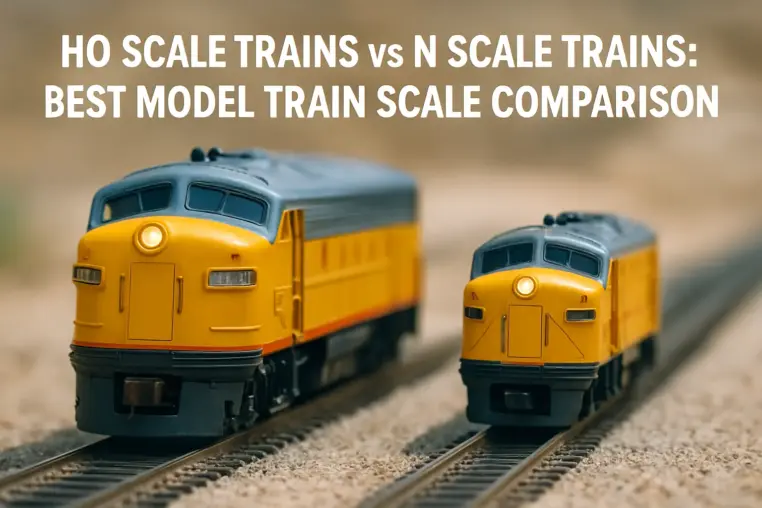
HO scale and N scale are the two most widely used scales in the hobby. Both have strong manufacturer support, lots of available accessories, and active communities. However, they serve different types of modelers. HO scale is larger and easier to handle, while N scale is smaller and better suited for compact layouts. The best choice depends on your space, budget, and what you want from your model trains.
HO Scale Trains: The Popular Middle Ground

HO scale is one of the most established and widely used scales in the hobby. It is 1:87 in size, meaning the model is 87 times smaller than the real train. One of the biggest reasons people choose HO scale trains is that they offer a strong balance between size and detail. They are large enough to allow for impressive detailing, yet small enough for most home layouts.
Advantages of HO Scale Trains
HO scale offers several major benefits:
– Detailed appearance: Because the models are larger than N scale, manufacturers can include fine details such as handrails, cab interiors, grab irons, and realistic paint schemes.
– Easier handling: HO locomotives and cars are easier to place on the track, couple together, and maintain.
– Wide product selection: The market for HO scale trains is huge, which means more choices in locomotives, freight cars, passenger cars, track systems, buildings, and scenery items.
– Good for beginners and advanced hobbyists: HO is often recommended for newcomers because it is easier to work with, while experienced modelers appreciate its realism and customization potential.
Challenges of HO Scale
HO scale does have some drawbacks. It takes up more room than N scale, so building a large, realistic layout can be difficult in a small apartment or spare bedroom. A longer train also needs wider curves and more space overall. If your goal is to create a sprawling railroad with mountains, industries, towns, and long mainline runs, HO may require a dedicated area.
N Scale Trains: Small Size, Big Possibilities
N scale trains are much smaller than HO scale, with a scale ratio of 1:160 in most regions. This compact size is one of the biggest reasons the scale has grown so popular. N scale allows hobbyists to fit more track, more scenery, and longer trains into limited space.
Advantages of N Scale Trains
N scale has unique strengths that make it appealing to many modelers:
– Space efficiency: You can create a larger-looking layout in a much smaller area.
– Longer trains in less space: Because the cars and locomotives are smaller, you can run realistic-length trains even on modest layouts.
– Great for scenery-heavy layouts: N scale is ideal for creating sweeping landscapes, mountain railroads, and extensive mainline operations.
– Easier to expand: A small N scale layout can grow into a more complex model railroad without requiring a big room.
Challenges of N Scale
Despite its benefits, N scale can be more challenging in some areas. The smaller size makes it harder to handle, especially for modelers with limited dexterity. Detailing is more delicate, and coupling rolling stock can be trickier than in larger scales. Some beginners also find maintenance and track cleaning slightly more demanding because of the compact size of the equipment.
HO Scale Trains vs N Scale Trains: Side-by-Side Comparison
When comparing HO scale trains and N scale trains, the best choice often comes down to practical considerations rather than one scale being universally better.
Space Requirements
If you have a large room or basement, HO scale gives you plenty of options for building realistic scenes with visible detail. If your space is limited, N scale is usually the better option because you can fit much more layout into the same footprint.
Detail and Realism
HO scale generally wins when it comes to visible detail. The larger size makes it easier to add realistic features and to notice them from a normal viewing distance. N scale has improved dramatically over the years, though, and modern model trains in N scale can still look very convincing, especially when viewed as part of a full scene.
Ease of Use
HO is more forgiving for beginners. The larger parts are easier to grasp, and track work, wiring, and maintenance are generally simpler to manage. N scale requires more precision and patience, but many experienced hobbyists enjoy that challenge.
Cost
Costs can vary widely, but N scale often provides more layout for the money because less material is needed for track, scenery, and structures. However, individual N scale models can sometimes cost nearly as much as HO items due to manufacturing complexity. Overall, both scales can be affordable or expensive depending on the quality level you choose.
Layout Design Options
N scale is excellent for building large-looking railroads in limited space, with wide mountain passes, long bridges, and extended mainline runs. HO scale works well for switching layouts, realistic industrial scenes, and detailed urban or rural settings. Both scales can support any type of railroad theme, but they do so differently.
Which Scale Is Best for Beginners?
For many beginners, HO scale trains are the safest starting point because they are easier to work with and offer a huge range of starter sets, accessories, and tutorials. If you are new to the hobby and want a straightforward introduction to building a model railroad, HO scale can make the learning curve less steep.
That said, N scale is an excellent choice if space is your biggest concern. A beginner who lives in a small apartment or wants a portable layout may find N scale more practical from the beginning. There is no wrong answer—only the scale that best matches your goals.
Choosing the Right Scale for Your Model Railroad
When deciding between the two, ask yourself a few simple questions:
– How much space do I have?
– Do I want more detail or more layout?
– Will I enjoy working with smaller parts?
– What kind of railroad do I want to build?
– Do I plan to display my trains, operate them, or both?
If you want maximum visual detail and easier handling, HO scale trains are likely the better fit. If you want to maximize scenery and track in a smaller area, N scale trains may be ideal. Many hobbyists even enjoy both scales for different projects.
Final Thoughts
Both HO and N scale have earned their place in the hobby because each offers something valuable to model railroaders. HO scale is the classic choice for detail, ease of use, and variety. N scale is the smart choice for compact layouts, long trains, and scenic freedom in limited space. The best model train scales are the ones that match your available room, budget, and creative vision. Whether you choose HO or N, the most important part is building a model railroad that you enjoy bringing to life.

