

 Written by
 HO Scale Trains vs N Scale Trains: Best Model Railroad Guide
HO scale trains and N scale trains are the two most popular choices for hobbyists building a model railroad. If you are just getting started with model trains, or you are thinking about expanding an existing layout, understanding the strengths and trade-offs of each scale can help you make a smarter decision. Both options offer impressive realism, wide product availability, and endless creative possibilities, but they serve different goals depending on your space, budget, and preferred style of operation.
Understanding Model Train Scales

Before comparing the two directly, it helps to understand what scale means. In the world of model train scales, the term refers to how large the model is compared to the real locomotive, freight car, or passenger car it represents. A smaller scale allows you to fit more railroad into a limited space, while a larger scale often makes handling, detailing, and maintenance easier.
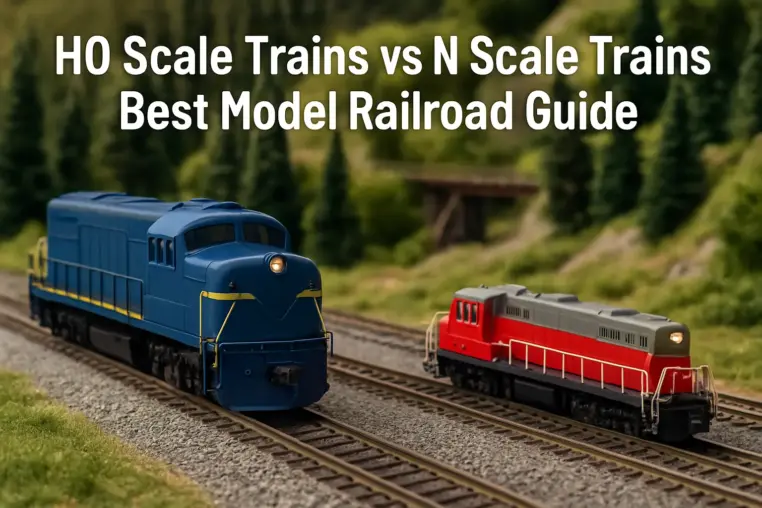
The main difference between HO and N scale is size. HO scale is larger, while N scale is much smaller. That simple distinction affects nearly every part of the hobby, from scenery and track planning to pricing and realism.
HO Scale Trains: The Most Popular Choice

HO scale is often considered the standard for beginners and experienced modelers alike. Its size makes it a practical middle ground between detail and space efficiency. Many hobbyists prefer HO scale trains because they are large enough to handle comfortably but still small enough to create a substantial layout in a spare room, basement, or dedicated hobby space.
Advantages of HO Scale Trains
One of the biggest benefits of HO scale is the wide range of products available. Since it is the most popular scale, manufacturers produce a huge selection of locomotives, rolling stock, structures, accessories, and track components. That makes it easier to find exactly what you want, whether you are modeling modern freight operations, passenger service, or a vintage steam-era line.
HO scale is also known for strong detail. The cars and engines are large enough to support realistic paint schemes, fine handrails, and detailed interiors. For many modelers, that balance between size and realism is one of the main reasons they choose HO.
Another major advantage is ease of maintenance. Because the models are larger, they are easier to couple, uncouple, clean, and repair. This can be especially helpful for beginners or hobbyists who want a more forgiving experience.
Challenges of HO Scale Trains
The biggest drawback to HO scale is space. Even though it is more compact than larger scales, a realistic layout can still require a significant footprint. Tight curves and short sidings may limit operation if your room is small. If you dream of long mainlines or big yard operations, you may need a larger area to do it properly.
N Scale Trains: Big Railroad in a Small Space
N scale trains are much smaller than HO, making them a favorite for modelers who want to build more railroad in less room. If your goal is to create a large scenic landscape, long runs, or a busy operating layout in a compact area, N scale can be a fantastic choice.
Advantages of N Scale Trains
The most obvious advantage of N scale is space savings. Because the trains are smaller, you can fit more track, more towns, and more scenery into the same footprint. This makes N scale especially appealing for apartment layouts, shelf layouts, and modelers working with limited space.
N scale also allows for impressive scene depth. A layout can feel much larger than it actually is because the smaller trains create the illusion of distance. For modelers who enjoy mountain passes, long bridges, broad yards, and sprawling mainlines, this is a major benefit.
Another plus is portability. Smaller models and track plans often make N scale layouts easier to move or store. Some hobbyists even build modular layouts that can be assembled and disassembled with relative ease.
Challenges of N Scale Trains
N scale does have some trade-offs. Because the trains are smaller, handling them can be more difficult, especially for modelers with limited dexterity. Coupling cars and performing maintenance may require more patience and precision.
Detailing, while very good in modern N scale products, can also be less visually prominent than in HO scale. Some hobbyists simply prefer the substantial feel of larger models. In addition, although the selection is excellent, it may not match the sheer volume of choices available in HO scale.
HO Scale Trains vs N Scale Trains: Which Is Better?
There is no single winner in the HO scale trains vs N scale trains debate. The best choice depends on what matters most to you in the hobby.
Choose HO scale if you want:
– Easier handling and maintenance
– A huge variety of products
– Strong visual detail
– A balance between size and layout potential
– A more traditional model railroad experience
Choose N scale if you want:
– Maximum layout in minimum space
– Long mainlines and expansive scenery
– A compact, portable setup
– The ability to model a larger railroad in a smaller room
– A layout that emphasizes overall scene and operation
If you have the room and enjoy working with larger models, HO scale may feel more satisfying. If your layout space is tight or you want to build a bigger world in a smaller area, N scale may be the smarter pick.
Matching Scale to Your Layout Goals
Your choice of scale should reflect how you want to enjoy the hobby. Some modelers love building highly detailed switching layouts, while others care more about train length, continuous running, and scenic realism. The right scale supports your goals rather than limiting them.
For example, if you are designing a shelf layout in an apartment, N scale may let you include more track and scenery without crowding the room. If you are building a club layout or have a dedicated basement, HO scale may provide the size and presence you want.
It is also worth thinking about your long-term plans. If you want to collect a large fleet of locomotives and cars, the cost and storage requirements of each scale will matter. HO items are larger and can take up more space, while N scale pieces are smaller and easier to store in quantity.
Budget and Availability
Budget is another important factor. While prices vary widely by manufacturer and quality level, both scales offer options for beginners and advanced hobbyists. Because HO is so common, you may find more variety at every price point, including used equipment. N scale also offers a broad range of choices, and the smaller size can sometimes allow you to buy more rolling stock for the same display space.
Track, scenery, buildings, and electronics should also be considered. A larger layout in HO may require more materials overall, while an N scale railroad may allow you to stretch your budget further by covering more area with less product.
Final Thoughts
When comparing HO scale trains and N scale trains, the best choice comes down to personal priorities. HO scale is ideal for hobbyists who value detail, ease of handling, and a broad product selection. N scale is perfect for those who need to maximize space and want to build a larger railroad in a smaller footprint.
Both scales are excellent entry points into the world of model trains and model railroad building. Whether you choose the bigger feel of HO or the compact efficiency of N, the most important thing is selecting the scale that inspires you to keep creating, operating, and enjoying the hobby for years to come.

