Model Train Table Build Guide for Beginners: Start Your Layout
Getting started with model railroading is exciting — but it can also feel overwhelming. This model railroad beginner guide walks you through building a sturdy table, planning track, wiring power, and adding scenery so you can start running trains quickly. Whether you’re exploring model trains for beginners, dreaming of custom model trains, or curious about model railroad modding, this guide will give you practical steps, examples, and tips to get your first layout up and running. For more insights, check out the Beginner’s Guide to Model Trains —
Why Start with a Good Table?
A solid table (benchwork) is the backbone of your layout. It supports track, scenery, electronics, and anything you’ll customize later. A well-built table:
– Provides accessible wiring and storage below the layout.
– Prevents warping or sagging over time.
– Makes future expansions, modding, and custom model trains easier.
Most beginners choose a 4×8-foot table—big enough for a meaningful layout but small enough to build in a garage or spare room.
—
Planning Your Layout
Define Your Goals
Ask yourself:
– Do I want running sessions or a modeling-focused display?
– What scale: HO, N, O, or something else?
– How much space, time, and budget do I have?
Common beginner choices:
– HO scale (1:87) — widely available, balanced detail and space.
– N scale (1:160) — fits more in a small area.
– O scale — larger but needs more space.
Space, Size, and Budget
– Space: Identify a spot with at least a foot of clearance around your table.
– Size: 4×8, 2×4 shelf modules, or an L-shape for corners.
– Budget: Starter layouts can cost $300–$1,000; more elaborate DCC or custom modeling increases cost.
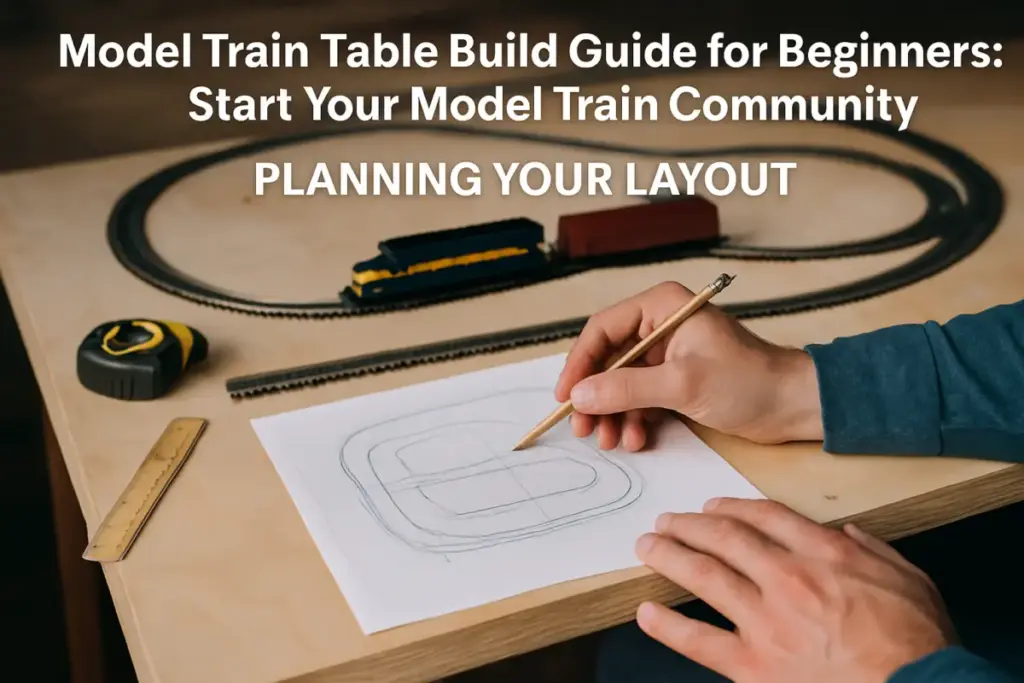
Sketch a Simple Plan
Example: A 4×8 beginner plan
– Outer loop for continuous running (mainline).
– Inner reverse loop or passing siding for switching.
– Small town scene with a freight yard and an industrial spur.
– Benchwork with access doors and a control panel at the front.
Use graph paper or simple software (see below) to plan.
—
Building the Table and Benchwork
Types of Benchwork
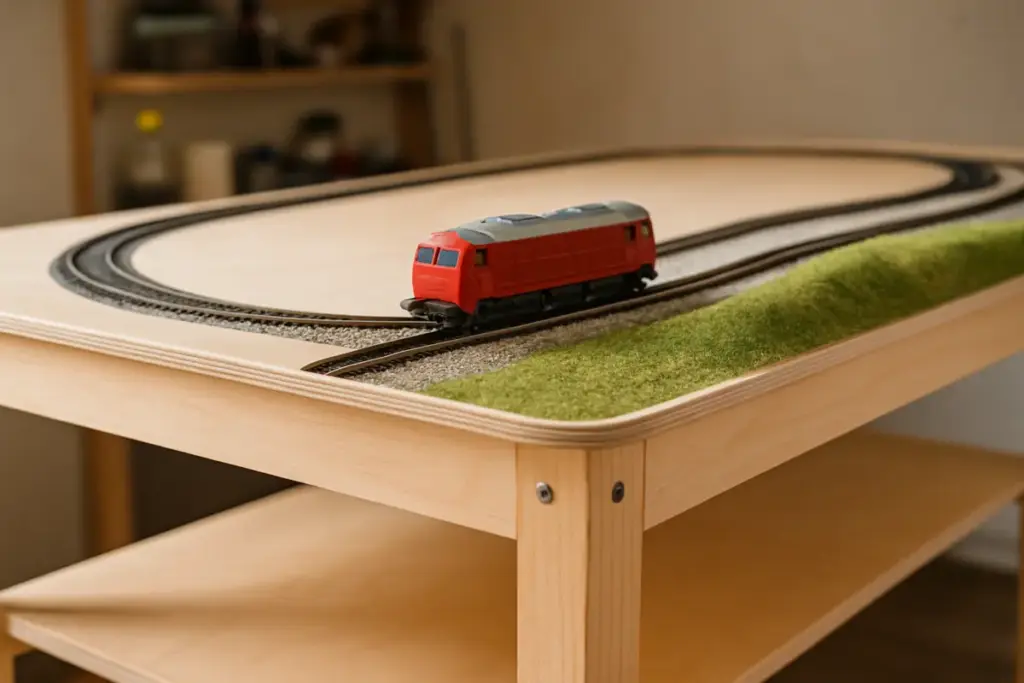
– Flat sheet-on-frame: Plywood top on a 2×4 or 1×3 frame. Simple and stable.
– Open Grid: Lightweight, easy to run wiring underneath; more advanced.
– L-girder: Strong, flexible for custom curves and terrain; favored by experienced modelers.
For beginners, plywood-on-frame is fastest and most reliable.
Materials and Tools
Materials:
– 3/4″ plywood (4×8 sheet) for top
– 2x4s or 2x3s for frame and legs
– 1x3s for inner support rails
– Wood screws, glue, corner braces
– Optional: Homasote or cork roadbed, foam insulation (pink/blue) for scenery base
Tools:
– Circular saw or table saw
– Drill/driver
– Measuring tape, square, level
– Clamps, sanding block, jigsaw (for cutouts)
– Paint and brushes (for basecoat)
Step-by-Step 4×8 Table Build
1. Cut two 4′ 2x4s and six 8′ 2x4s (or adjust for frame width).
2. Assemble a rectangular frame using 2x4s: two long side rails and two end rails. Use wood glue and screws.
3. Add cross braces every 16–24 inches for support.
4. Attach legs at corners and midpoints. Consider detachable legs if portability matters.
5. Screw 3/4″ plywood sheet to frame. Fill seams or screw holes with wood filler if you plan to paint.
6. Add an underframe shelf or skirt for wiring and access doors.
7. Attach 1×3 rails on top of the plywood where you’ll place track to support foam/scenery.
Tips:
– Add a hinged access panel if the table will abut a wall.
– Ensure everything is level—use shims under legs as needed.
—
Track Planning and Laying Track
Choosing Track
Brands: Atlas, Peco, Bachmann, Micro Engineering. For beginners:
– Peco code 100 (HO) or code 80 for smoother running.
– Snap-fit track is easiest; soldered joints are more reliable long-term.
Consider flexible track for curves and ease of layout.
Tools and Materials
– Track pieces (straight, curved, turnouts)
– Cork or foam roadbed
– Rail joiners, fishplates
– Track nails or adhesive
– Small files, rail cutters, alignment gauges
Track Planning Software
– SCARM, AnyRail, XTrackCAD — helpful to draw track and check clearances.
– For beginners, hand-drawn plans on graph paper work fine.
Laying Track: Basic Steps
1. Lay out track dry on the table to test fit.
2. Glue down roadbed (cork or foam) following your plan.
3. Lay track on roadbed and secure with track nails or adhesive.
4. Ensure smooth transitions at joints—file ends if needed.
5. Install turnouts; check smooth switching with a light-weight car.
Example: Two-track oval with a siding
– Outer loop for continuous running, inner loop for shorter trains.
– A passing siding connects the two, allowing for meets or storage.
– Add a small spur to a warehouse scene for operations practice.
Track Geometry and Clearances
– Minimum curve radius depends on scale/rolling stock: HO common minimum is 18–22″ for starters; larger is smoother.
– Check coupler and car clearance on turnouts and crossings.
– Avoid sharp S-curves and sudden grade changes.
—
Wiring, Power, and Controls
DC vs DCC: Which to Choose?
– DC (Direct Current)
– Simpler and cheaper for a single train operation.
– Each isolated block controls speed/direction via a controller.
– DCC (Digital Command Control)
– Each locomotive has a decoder and can be independently controlled on the same track.
– Better for multiple trains and model train customization (installing decoders, sound, lighting).
Recommendation: For beginners aiming to expand and customize later, start with a basic DCC system. For pure simplicity and lowest cost, DC is acceptable.
Basic Wiring Concepts
– Bus wires: Thick wires (14–16 AWG) running under the table.
– Feeder wires: Thinner wires (18–22 AWG) from bus to track every 3–6 feet.
– Solder feeders to track rail or use screw terminal connectors.
Example wiring plan for a 4×8 with DCC:
– Single DCC booster connects to two feeder zones (outer loop and inner tracks).
– Turnout motors get auxiliary power either from accessory bus or a decoder.
Turnout and Frog Wiring
– Insulated frogs simplify wiring but might need polarity switching for power routing.
– Use switch machines with frog-power control or DCC turnout decoders for reliability.
Common Wiring Mistakes
– Relying on rail joiners for all electrical connections — add feeders to avoid voltage drop.
– Not using a common bus for all sections — complicates troubleshooting.
– No test points — add terminal strips for easier diagnostics.
—
Scenery and Landscaping Basics
Scenery turns bare track into a believable world. You don’t need professional skills to get great results.
Base Materials
– Foam (extruded rigid foam) — lightweight, easy to shape.
– Plaster cloth — good for hills and smooth contours.
– Homasote — traditional roadbed/ballast base for sound deadening.
Groundwork Steps
1. Paint the plywood base with earth-tone latex paint to block shine.
2. Place foam sheets and carve contours for hills and roads.
3. Cover with plaster cloth or diluted plaster of Paris for a hard shell.
4. Paint base colors (earth, road, paved areas).
5. Glue down static grass, turf, and scatter for ground cover.
6. Ballast track using diluted white glue and a fine ballast material.
Buildings and Details
– Start with ready-to-run kits for buildings; inexpensive and easy to assemble.
– For custom model trains and model train customization, you can kitbash (mix parts) and repaint to match your era.
– Small details (figures, signage, vehicles) bring scenes to life.
Example: Small Town Scene
– Place a single main street with 2–3 buildings (hardware store, diner, depot).
– Add a siding that serves a grain elevator or factory.
– Use trees and fences to frame the scene.
—
Rolling Stock, Locomotives, and Customization
Starter Sets and Roster Building
– Begin with a starter set that includes a locomotive, cars, track, and a controller.
– Expand your roster by adding freight cars, passenger cars, and specialty equipment.
Model Train Customization and Modding
Customizing and modding breathe personality into your layout:
– Painting and weathering:
– Use acrylics or enamels; dry brushing and washes for grime.
– Weathering powders simulate rust and soot.
– Coupler upgrades:
– Swap cheap knuckle couplers for reliable Kadee or similar types.
– Lighting:
– Install LED interior lighting in cars and buildings.
– DCC decoders and sound:
– Install decoders in locomotives for independent control.
– Add sound decoders for realism (horns, engine noises).
– Structural mods:
– Kitbash buildings, scratch-build details, and customize freight loads.
Example Mod: Install an LED Lighting Kit and DCC decoder in an HO loco
1. Open locomotive shell and identify motor and pickup points.
2. Solder decoder wires to motor and pickups following decoder wiring diagram.
3. Add a small 0603 or 0805 LED and resistor for headlights; connect to lighting function outputs.
4. Test on a DCC system before closing shell. Program address and function mapping.
—
Tools, Materials, and Budgeting
Essential Tools
– Hobby knife, small screwdrivers, needle-nose pliers
– Soldering iron (25–40W) and rosin-core solder
– Wire strippers, multimeter
– Pin vise and small files
– Paintbrushes and airbrush (optional)
Optional/Advanced Tools
– Dremel or rotary tool
– Foam cutter or hot-wire cutter
– Track gauge and track cleaning tools
– Computer and DCC programming tools
Budget Examples (Beginner)
– Basic starter set (HO): $150–$300
– 4×8 table (materials): $150–$300
– Track for 4×8 (enough to do loops and sidings): $150–$300
– DCC starter system: $150–$400
– Scenery materials and buildings: $100–$300
Total beginner budget: $700–$1,800 depending on choices and how much you DIY.
—
Tips, Maintenance, and Community
Maintenance Checklist
– Clean track regularly with a rag or track cleaning solution.
– Clean wheels on locomotives periodically.
– Lubricate motor and axles lightly; avoid over-lubrication.
– Check electrical connections and solder joints annually.
Troubleshooting Quick Tips
– If a loco stalls on a turnout: check for debris, poor electrical contact, or gapped rails.
– Intermittent power: add more feeders or inspect rail joiners.
– DCC address issues: verify decoder programming and short circuits.
Join the Community
– Local clubs: great for advice, sharing layouts, and operating sessions.
– Online forums and YouTube channels: abundant tutorials on “how to start model trains” and “model railroad modding.”
– Local hobby shops: invaluable for supplies, advice, and sometimes workshops.
—
Example Beginner Project Timeline
Week 1: Plan layout, pick scale, buy materials for table.
Week 2: Build benchwork and plywood top.
Week 3: Paint base, install roadbed, and lay mainline track.
Week 4: Wire feeders and test power (DC or DCC).
Week 5: Add turnouts, sidings, and ballasting on mainline.
Week 6–8: Start simple scenery (foam hills, grass), place buildings.
Ongoing: Expand rolling stock, start custom model trains/decoders, and tweak scenery.
This timeline assumes part-time weekends—adjust for your pace.
—
Safety and Workspace Organization
– Work in a ventilated area, especially when painting or using glue.
– Use eye protection when cutting lumber or plastic.
– Keep a tidy tools area; label wires and parts to avoid confusion.
—
Conclusion
Starting a model train table is a rewarding mix of carpentry, electronics, and creative modeling. This model railroad beginner guide gives you the foundation to plan, build, wire, and begin scenic work on a dependable 4×8 layout. Begin with a clear plan, choose the right scale and control system for your goals, and grow into model train customization and model railroad modding as your skills and interest expand. Join a community, practice basic maintenance, and most of all—enjoy running trains. Your first layout is just the start of many creative possibilities.


 Written by