

 Written by
 HO Scale Trains vs N Scale Trains: Best Model Railroad Guide
HO scale trains are often the first thing people think of when they picture model railroading, but N scale trains have become just as popular for hobbyists who want to build detailed layouts in a smaller space. Choosing between these two options is one of the biggest decisions in the hobby, because it affects everything from layout size and scenery to cost, realism, and ease of operation. If you are planning a new model railroad, understanding the strengths and limitations of both scales will help you make the best choice for your goals.
Understanding Model Train Scales

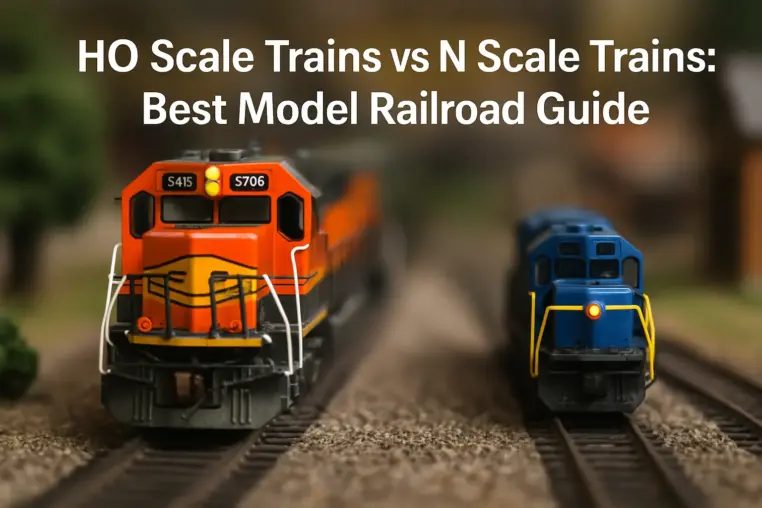
Before comparing the two, it helps to know what model train scales actually mean. A scale is the ratio between the model and the real-life train it represents. HO scale is 1:87, meaning the model is 87 times smaller than the prototype. N scale is smaller, typically 1:160 in North America, which allows trains to fit into a much more compact layout.
Both scales are widely used in model trains, and both offer extensive product availability, including locomotives, freight cars, passenger cars, track systems, buildings, and accessories. The main difference is not just size, but how that size changes the overall modeling experience.
HO Scale Trains: The Most Popular Choice

HO scale is the most common scale in the hobby, and for good reason. It offers a strong balance between detail and layout flexibility. The models are large enough to include impressive detailing, yet small enough to let hobbyists build realistic railroads in a moderate-sized space.
One of the biggest advantages of HO scale is the wide selection of products. Because it is the most popular of all model train scales, manufacturers produce a huge variety of locomotives, rolling stock, structures, and scenery items. This makes it easier to find equipment from different eras, railroads, and regions.
HO scale is also beginner-friendly in many ways. The trains are easier to handle than smaller scales, which can be helpful when installing couplers, adding details, or performing maintenance. For modelers who enjoy weathering, detailing, and customizing their locomotives and cars, HO provides enough size to work comfortably.
Another advantage is realism. HO scale trains often allow for more visible detail on cars, buildings, and figures. If you want your model railroad to showcase craftsmanship and look impressive up close, HO scale is a strong option.
That said, HO scale does require more space than N scale. A realistic layout with broad curves, long trains, and multiple industries can quickly take over a room. For many hobbyists, this is the main factor that pushes them to consider a smaller scale.
N Scale Trains: Big Layouts in Small Spaces
N scale trains are the go-to choice for people who want to create a large, impressive railroad in a limited area. Because the trains are much smaller, you can fit more track, longer mainlines, more scenery, and larger operating areas into the same space that HO would require.
This makes N scale especially appealing for apartment dwellers, small rooms, and anyone who wants to model mountains, deserts, urban scenes, or long-distance railroading in a compact form. If your dream is to watch trains wind through sweeping landscapes, N scale can deliver that effect beautifully.
Another benefit of N scale is the ability to model more of the railroad’s environment. Since the trains take up less room, the scenery often becomes a bigger visual part of the layout. That can create a very immersive effect, especially for modelers who enjoy broad vistas and realistic geography.
In recent years, N scale has improved significantly in quality. Modern products are much more detailed, reliable, and smooth-running than older generations of N scale equipment. Many hobbyists now see it as a serious alternative to HO rather than just a space-saving compromise.
The trade-off is that smaller size can make handling and maintenance more challenging. Couplers, tiny details, and track cleaning can be more difficult. Some beginners may find N scale a little less forgiving, especially when it comes to eyesight and dexterity.
HO Scale Trains vs N Scale Trains: Key Differences
When comparing HO scale trains and N scale trains, the best choice depends on what matters most to you. Here are the main areas to consider:
Space Requirements
HO scale needs more room, but it rewards that space with easier handling and visible detail. N scale is ideal when space is limited and you want to fit more railroad into less area.
Detail and Appearance
HO scale generally offers better visual presence and easier detailing. N scale has improved a lot, but its smaller size still makes some details less noticeable.
Operation and Maintenance
HO scale is easier to work on, especially for beginners. N scale requires more careful handling due to its smaller parts.
Layout Possibilities
N scale allows more complex track plans in a given area. HO scale often requires more selective planning but can still create stunning layouts if enough space is available.
Cost
Pricing varies by brand and quality, but both scales can be expensive. N scale equipment may sometimes cost slightly less, but a larger HO layout can also become costly because it uses more space and materials.
Which Scale Is Better for Beginners?
There is no single answer, because the best choice depends on your priorities. If you want easier handling, strong detail, and a large product selection, HO scale is often the better starting point. If you have limited room and want to create a more expansive railroad scene, N scale may be the smarter option.
For many newcomers to model trains, HO is recommended because it is easier to work with and has a huge support network of products and information. However, if space is tight, choosing HO only to later discover you cannot build the layout you want can lead to frustration. In that case, N scale may be a better fit from the start.
Matching Scale to Your Modeling Goals
Think about what kind of model railroad you want to build. If you love switching operations, close-up details, and hands-on building, HO scale may suit you best. If you are more interested in long mainlines, scenic backdrops, and maximum track in minimal space, N scale could be ideal.
Also consider your budget, the era you want to model, and whether you plan to operate trains alone or with others. If your layout is likely to live on a shelf, under a bed, or in a small spare room, N scale is especially attractive. If you have a dedicated basement, garage, or large hobby room, HO scale opens the door to more elaborate possibilities.
Final Thoughts
Both HO and N scale have earned their place among the most popular model train scales. HO offers ease of handling, strong detail, and unmatched product variety. N scale delivers impressive operation and scenery in a much smaller footprint. Neither is universally better; each excels in different situations.
The best scale is the one that fits your space, budget, and vision for the hobby. Whether you choose the larger presence of HO scale trains or the compact versatility of N scale trains, you can build a rewarding and creative model railroad that reflects your interests and style.

