

 Written by
 Essential Model Railroad Tools for Model Train Customization and Modding
Custom model trains and model railroad modding are deeply satisfying hobbies that blend craftsmanship, electronics, and artistry. Whether you’re repainting a steam locomotive, installing a sound decoder in an N scale diesel, or scratch-building a freight car, the right set of tools makes the difference between frustration and excellent results. This guide covers the essential tools for customizing and modding model trains, organized by purpose and level of investment, with practical examples and checklists so you can get started confidently.
Why the Right Tools Matter
– Precision: Model railroad parts are small and delicate. Proper tools give you the control needed to cut, file, solder, and assemble with minimal risk of damage.
– Efficiency: A screwdriver is fine—but a precision driver set saves time and reduces frustration.
– Quality of finish: Good paint, sanding, and airbrushing tools produce professional-looking custom model trains.
– Safety: Proper soldering equipment, ventilation for paints/solvents, and eye protection keep you safe while working on electronics and paints.
Whether you’re doing light customization or full-blown modding, the following tools will serve you well.
—
Overview: Tool Categories

– Hand tools (cutting, holding, fastening)
– Shaping and finishing tools (files, sanding, rotary tools)
– Painting and finishing (airbrush, brushes, masking)
– Electronics and wiring (soldering stations, multimeter, decoders)
– Measuring and gauging (calipers, NMRA gauges)
– Scenic and layout tools (hot wire cutter, foam tools)
– Specialized model-railroad tools (coupler tools, wheel pullers, track gauges)
—
Hand Tools: The Foundation
These are indispensable for almost any customization or modding task.
– Precision screwdriver set: Phillips and flat drivers in small sizes, plus nut drivers for motor mounts and screws.
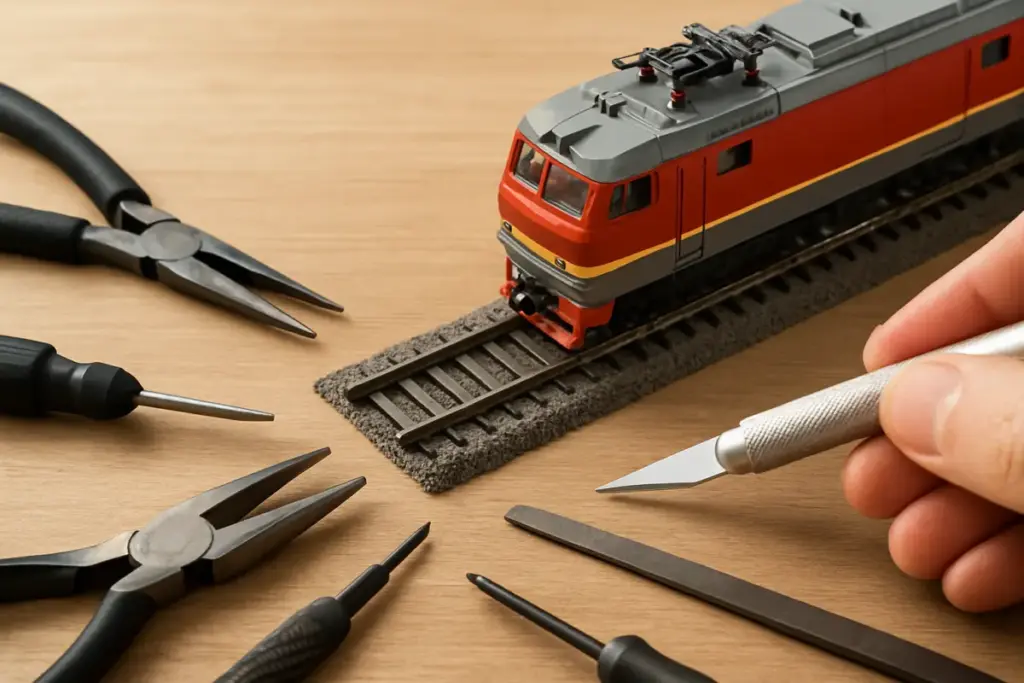
– Micro pliers: flat-nose, needle-nose, and round-nose pliers for bending, holding, and shaping wire or small parts.
– Flush-cutters: for trimming sprues, wire leads, and photo-etched parts cleanly.
– Tweezers: fine-point antimagnetic tweezers for decals, LEDs, and tiny parts.
– Hobby knives: a sharp X-Acto or similar with a variety of blades; essential for trimming, scraping, and delicate cutting.
– Small vise or helping hands: for holding parts during glueing, soldering, or painting.
Example use: Removing a coupler box to fit a new Kadee-style coupler requires screwdrivers, tweezers, and flush-cutters to trim interference. A small vise keeps the car steady while you work.
—
Shaping & Finishing Tools
Good finishing separates a toy from a scale accurate model.
– Needle files and small hand files: round, half-round, flat, and triangular files for fine shaping of plastic, brass, and axles.
– Sanding sticks and micro sandpaper (grits 220–2000): for smoothing seams, preparing surfaces for paint, and refining detail.
– Rotary tool (Dremel or Proxxon): cutting, drilling, and grinding small areas; useful with a variety of attachments like cutting wheels and sanding drums.
– Pin vise and micro drill bits: for drilling pilot holes for lights, grab irons, and detail parts.
– Scalpel or micro chisel set: for delicate reshaping and removal of flash from castings.
Tip: When filing rails or wheel flanges, use a fine-cut file and remove metal filings with a magnet and vacuum to avoid contaminating motors and gears (a common cause of future failure).
—
Painting and Finishing
A professional finish is often the most visible sign of high-quality customization.
– Airbrush and compressor: an airbrush gives smoother base coats and weathering effects than brushes; look for a dual-action airbrush and a small oil-lubed or diaphragm compressor with a moisture trap.
– Brushes: a set of high-quality sable or synthetic brushes for detail painting, washes, and touch-ups.
– Masking materials: low-tack masking tape, acetate masks, and liquid mask for complex schemes.
– Primers and paints: primers (gray or white) designed for plastic and metal; acrylics or enamels for model work. Testors, Tamiya, Vallejo, and AK Interactive are common choices.
– Weathering kits & pigments: pastel chalks, oil washes, and pigments help achieve realistic aging, grime, and rust.
– Clear coats: matte, satin, and gloss varnishes for sealing decals and weathering.
Example project: Spray a thin primer coat using an airbrush, then mask and apply the road-number panels. A light coat of matte varnish seals decals and dulls the model to prototype appearance.
—
Electronics & Wiring
Adding lights, smoke, or sound is where modding becomes truly transformative for model trains.
– Soldering station: temperature-controlled soldering iron (20–60W adjustable) with fine tips. Hakko and Weller are popular professional brands; a simple affordable station is fine for beginners.
– Fine solder and flux: 0.6–1.0 mm electronics solder (60/40 or lead-free with rosin flux). Flux pens and rosin-core solder for cleaner joints.
– Desoldering tools: solder wick and a small desoldering pump to remove old connections and components.
– Multimeter: digital multimeter with continuity, voltage, and current testing for troubleshooting.
– Wire assortment: 30–24 AWG insulated wires in multiple colors for lighting and motor wiring. Kynar/Enamel wire is good for small spaces.
– Heat shrink tubing and micro connectors: neat, reliable insulation and removable connections.
– LEDs & resistors: surface-mount or through-hole LEDs (0603, 0805, or 3mm/1.8mm) and resistors for marker lights, interior lighting, and headlights.
– DCC decoders & programming tools: if you run DCC, you’ll need decoders (locomotive and accessory), a programmer or DCC system, and wiring harnesses. Popular decoder manufacturers include Digitrax, TCS, and ESU; pick decoders sized for your scale and loco.
– DC sound solution: for DC layouts, devices like an MRC Tech 6 enable DCC sound decoders to operate on analog track. (Helpful when you want sound but prefer DC control.)
Safety note: Work in a well-ventilated area and avoid inhaling fumes from solder flux and solvents.
—
Measuring & Gauging
Accurate measurement ensures reliability and NMRA compliance.
– Digital calipers: for measuring wheel back-to-back, coupler dimensions, and clearance; 0.01 mm or 0.001″ resolution is ideal.
– NMRA gauges: coupler height gauge, wheel gauge, and track gauge ensure compatibility with standards. These inexpensive tools save a lot of troubleshooting.
– Small ruler and protractor: for layout and truck alignment, plus radius measurements on turnouts and track curves.
Example: Before installing couplers, use an NMRA coupler height gauge to ensure all cars couple reliably both when pulled and pushed.
—
Scenic & Layout Tools
While modding typically focuses on rolling stock, many modders also create custom scenery to match their modified models.
– Hot wire foam cutter: for shaping Styrofoam subterrain, hills, and embankments cleanly.
– Hot glue gun: for quick assembly and scenic fixes.
– Sculpting tools: for plaster, clay, or sculptamold terrain shaping.
– Scenic materials: ground foam, static grass applicator, flock, foliage clumps, and ballast.
– Fine spray bottle or mister: for applying diluted white glue for scenic adhesion.
Tip from experience: Using foam pads over plywood makes it easy to cut ditches, bury wiring, and embed components without crawling under the benchwork.
—
Specialized Model-Railroad Tools
These are specific to rolling stock and track-level modding.
– Wheel puller and axle press: remove and reinstall wheelsets without damaging gears.
– Wheel and track gauge tools: ensure wheel flanges and back-to-back spacing meet standards to avoid derailments.
– Coupler insertion/removal tools: make coupler swaps faster, particularly for Kadee and similar brands.
– Micro clamp set and straightening jigs: for bending grab irons and handrails to precise shapes.
– Small bench vise with soft jaws: for holding bodies and frames without marring finishes.
– Re-railer sections and track templates: useful for testing modified rolling stock on a dedicated re-railer track segment.
Practical advantage: A wheel gauge prevents months of vexing derailments by catching improperly spaced wheels before they hit the layout.
—
Advanced Tools & Technologies
For serious custom model trains and modern modding, these tools expand possibilities.
– 3D printer: FDM or resin printers enable printing custom parts—replacement details, housings, or entire small components. A resin printer yields higher detail for tiny parts.
– CNC milling or small lathe: for metal parts, drive shafts, and custom gears.
– Sound decoders and CV programming tools: for creating custom horn/whistle sequences and power management.
– Surface-mount soldering station or hot air rework: for modern tiny SMD LEDs and decoders.
– Oscilloscope (advanced): for diagnosing complex electrical issues with motors and decoders.
Example use: 3D-print a custom snowplow or rooftop air conditioner for a unique prototype, paint it, and mount with tiny screws.
—
Project Examples: Tools Required & Steps
Here are three common custom model trains projects and the tools you’ll need.
1. Install LED Headlights & Ditch Lights in a Diesel Loco
Tools:
– Soldering station, solder, flux
– 0603 or 0805 surface-mount LEDs or 3mm LEDs
– 0805 resistors as appropriate
– Wire (30–32 AWG), heat shrink
– Pin vise, micro drill bits
– Tweezers and magnifier
Steps:
1. Disassemble loco and identify headlight opening.
2. Drill pilot holes for LED leads or mount SMD LEDs directly to a small brass or PCB pad.
3. Solder LEDs with leads and connect resistors to appropriate voltage.
4. Route wires to a light board or directly to the motor/decoder connections.
5. Test with multimeter, reassemble, and seal with clear coat.
2. Install a Sound Decoder in an N Scale Steam Engine
Tools:
– DCC sound decoder (size-matched)
– Soldering station and thin solder
– Heater or small drill (for speaker opening if needed)
– Small speaker (compatible size)
– Sound insulating foam, double-sided tape
Steps:
1. Remove boiler and cab to access chassis.
2. Install sound decoder between motor pickups and motor, following manufacturer wiring.
3. Mount a speaker in the tender or cavity, glue in place with vibration-damping foam.
4. Program CVs for correct motor response and sound levels.
5. Test on programming track, adjust volumes, and reinstall shell.
3. Repaint & Weather a Freight Car for Realism
Tools:
– Airbrush and compressor
– Primer, base paints, and weathering washes
– Masking tape, liquid mask
– Sanding sticks for seam removal
– Decal setting solution and clear coats
Steps:
1. Strip old paint or clean surface, then apply primer.
2. Airbrush base color, masking panels for multi-color schemes.
3. Apply decals with setting solution, seal with gloss varnish.
4. Weather with oil washes, pigments, and dry-brush highlights.
5. Seal final finish with matte varnish.
—
Starter Kit vs Advanced Kit
Choose tools based on your ambitions.
Starter Kit (good for most beginners):
– Precision screwdriver set
– Hobby knife and spare blades
– Flush-cutters and tweezers
– Needle files and sanding sticks
– Basic soldering iron (temperature-controlled recommended)
– Digital multimeter
– Airbrush or a set of fine quality brushes
– Pin vise and micro drill bits
– NMRA coupler and track gauges
Advanced Kit (for serious modding/custom model trains):
– Temperature-controlled soldering station with fine tips
– Rotary tool (Dremel/Proxxon) with attachments
– Dual-action airbrush and compressor with moisture trap
– 3D resin printer or desktop FDM printer
– Hot wire foam cutter
– Wheel press/axle puller and wheel truer
– Surface-mount rework tools and hot air station
– DCC programmer and multiple decoders
—
Safety & Best Practices
– Ventilation: use a spray booth or work in a well-ventilated area for paints, solvents, and solder fumes.
– Eye protection: goggles for grinding, drilling, and when using rotary tools.
– Fire safety: keep a small fire extinguisher nearby when soldering or using flammable solvents.
– Cleanliness: vacuum and use a magnet to pick up metal filings; keep workspace tidy to find small parts.
– Documentation: photograph wiring and screw locations during disassembly to simplify reassembly.
—
Maintenance & Troubleshooting Tips
– Clean track and wheels regularly—dirty contacts cause intermittent operation and poor lighting.
– When replacing wheels or couplers, check back-to-back spacing and coupler height with gauges before installation.
– Use graphite or light lubricants sparingly on axles; avoid getting lubricants on pickups and contacts.
– If a modded car derails, isolate that car on a test track with a camera or mirror to observe the problem.
– Keep spare parts like couplers, screws, and small gears on hand—small parts break or wear out more quickly during modding.
—
Quick Checklists
Starter tool checklist:
– Precision screwdriver set
– Hobby knife and blades
– Flush-cutters and tweezers
– Needle files and sanding sticks
– Pin vise and drill bits
– Basic soldering iron, solder, and flux
– Multimeter
– NMRA gauges
Advanced tool checklist:
– Temperature-controlled soldering station
– Rotary tool + accessories
– Airbrush and compressor
– Hot wire foam cutter
– 3D printer (resin or FDM)
– Wheel press, wheel gauge, coupler tools
– DCC programmer and decoders
—
Conclusion
Custom model trains and model railroad modding reward patience, practice, and the right tools. Start with a solid foundation of hand tools, a decent soldering setup, measuring gauges, and an airbrush if you plan to paint. As your ambition grows, invest in specialized gear—like a rotary tool, 3D printer, and advanced electronics tools—to expand what you can create. Above all, work carefully, document your steps, and maintain a clean, ventilated workspace. With the right tools and techniques, you’ll transform ordinary model trains into unique, highly detailed custom model trains that bring your model railroad to life.

