

 Written by
 Model Train Layout Planning for Beginners
Whether you’re curious about model trains for beginners or ready to dive into your first layout, planning is the single most important step that determines how enjoyable and successful your hobby will be. This model railroad beginner guide walks you through everything from choosing a scale to wiring basics, layout ideas, construction tips, and common mistakes to avoid. By the end you’ll have a clear roadmap for how to start model trains and design a layout you’ll love to operate and expand.
Why Plan Before You Build?
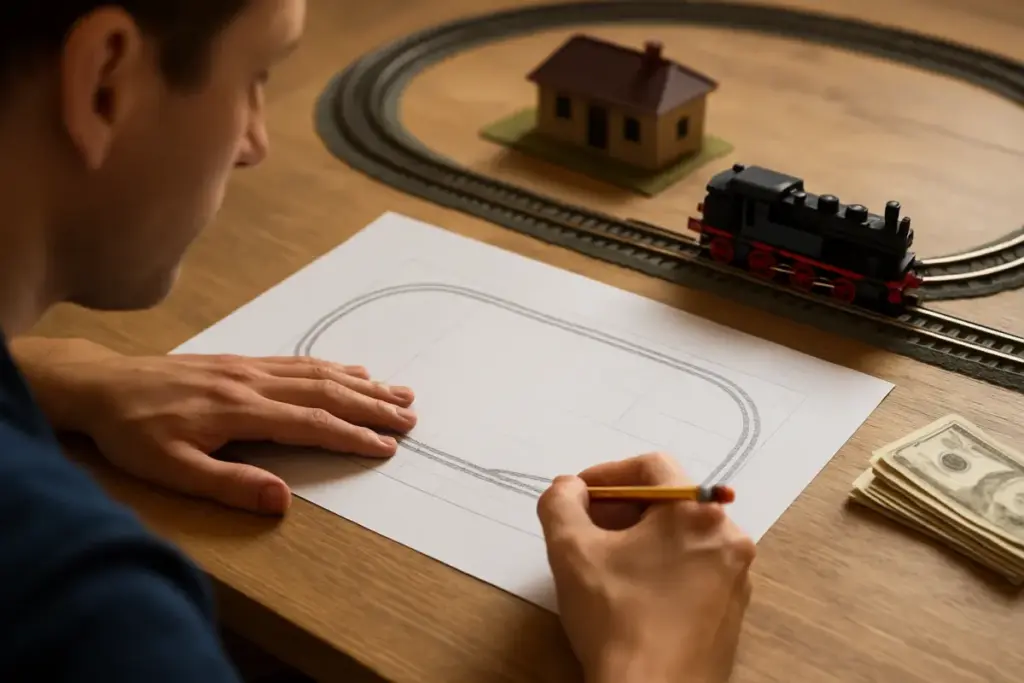
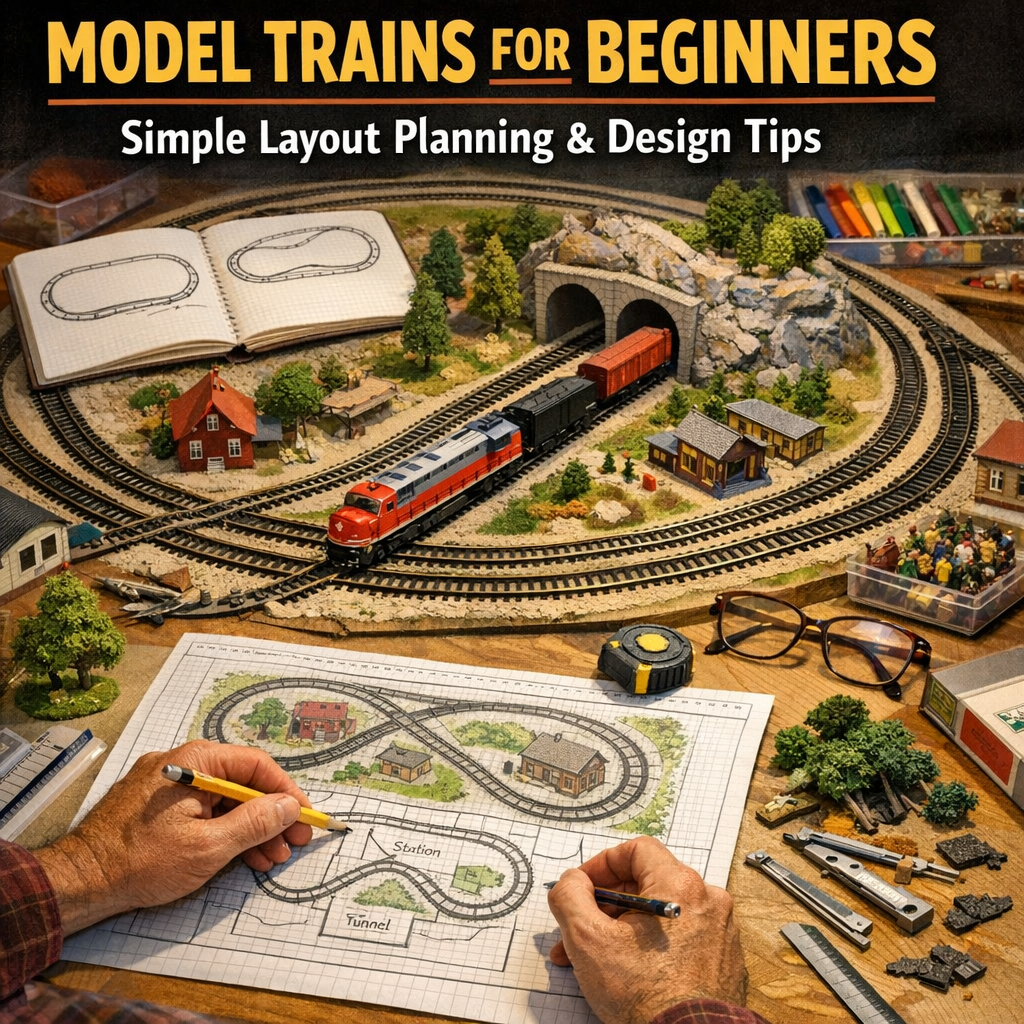
Jumping straight into building without a plan often leads to wasted time, money, and frustration. Thoughtful planning helps you:
- Match layout size and complexity to available space and budget
- Prioritize operations you’ll enjoy (scenery, switching, passenger runs)
- Avoid track geometry and electrical problems later
- Create a layout that is maintainable and expandable
This guide is intended as a model railroad layout design primer to help beginners make informed choices and start building confidently.
Start with Goals: What Do You Want from Your Layout?

Begin by asking simple questions. Your answers guide every design decision.
- Do you want to focus on realistic scenery, operations (freight/passenger switching), or running long trains?
- How much time and money can you commit?
- Will the layout be permanent or modular/portable?
- Are you interested in a specific era or region (steam era, modern diesel, British branchline)?
- Will others (family, kids) use it or is it a solo hobby?
Example goals:
- A small shelf layout for casual running and display of favorite locomotives
- A 4×8 basement HO layout focused on freight switching and a small yard
- A large multi-room layout with continuous-run mainline and realistic scenery
Write down 2–3 primary goals before you begin planning the track.
Choose a Scale and Gauge
Scale affects cost, space, detail, and availability of models. Common beginner choices:
- HO (1:87): Most popular, good balance of size, detail, and variety. Ideal for many model train layout ideas.
- N (1:160): Smaller; allows more complex track in less space. Good when space is limited.
- O (1:48) and G (1:22.5): Larger scales with robust models, often used outdoors (G gauge).
- TT (1:120) and others: Less common, with limited product availability.
For most beginners, HO or N are recommended due to wide product availability and community support. Pick a scale before buying track, locomotives, or accessories.
Decide Control: DC vs DCC
-
DC (Direct Current)
- Simpler and usually cheaper initially
- One speed control for all trains on a powered block
- Requires block wiring for independent control
-
DCC (Digital Command Control)
- Each locomotive has a decoder—multiple trains independently controlled on the same track without blocks
- Easier to operate multiple trains and enables sound and lighting control
- Higher initial cost and slightly more complex wiring, but widely recommended for new layouts if budget allows
For many beginners, starting with DC on a simple layout can be fine. However, if your budget permits and you want independent train control, choose DCC from the start to avoid future rewiring.
Plan the Space and Benchwork
Measure your available space realistically. Consider:
- Height of the benchwork (comfortable for long hours; 36–42 inches is typical)
- Access for maintenance (walk-around vs. reach-in)
- Windows, doors, HVAC, and moisture (avoid basements with flooding risk)
Common layout footprints for beginners:
- 4×8 feet (HO): Standard starter size, supports a main oval with yard and small town
- Shelf layouts (any length, 12–24 inches deep): Great for narrow spaces and display
- L-shape for corners: Utilizes corner space well
- Around-the-room in N or HO for continuous running and visual variety
Benchwork construction options:
- Simple legs and plywood top for temporary layouts
- L-girder or torsion box for larger, rigid layouts
- Modular frames with removable sections for storage or expansion
Tip: Build the benchwork slightly oversize to allow for fascia, walkways, and scenic overhangs.
Track Planning Basics
Good track planning balances realism, operability, and construction ease.
Key elements:
- Mainline geometry: Plan gentle curves and avoid tight radii for longer rolling stock. HO minimum recommended radius is 18–22 inches for newcomers; use larger radii when possible.
- Turnouts (switches): Use curved and tangent turnouts appropriate to the space. Number and placement affect operations and yard functionality.
- Grades and grades limits: Keep grades under 2% for ease of operation (1–1.5% preferred). Steep grades are realistic for mountain scenes but require planning for locomotive performance.
- Clearances: Leave space for wide cars at curves and for structures along the right-of-way.
- Yard and industries: Size your yard and spurs to accommodate the number of cars you want to operate.
- Return loops: Allow reversing sections with proper wiring (use auto-reverser or DCC reversing module).
Example small plan (HO, 4×8):
- 6-inch wide border for scenery/fascia
- 20-inch radius outer mainline curve, 16-inch inner radius if double-tracked (minimum)
- Small three-track yard (10–12 car spots) on one edge
- Town scene with depot and one industry spur
Use graph paper or free software (SCARM, AnyRail, XTrackCAD) to sketch and test track plans before cutting plywood.
Model Train Layout Ideas for Beginners
Here are beginner-friendly layout ideas to match different goals and spaces:
-
Oval with Yard (4×8 HO)
- Purpose: Continuous running and light switching
- Features: Two-track mainline, three-track staging yard, single industry spur
- Good for displaying trains and learning trackwork basics
-
Switching Puzzle / Inglenook (Shelf or 4×6)
- Purpose: Operational challenge for yard switching and car sorting
- Features: Small yard, 5–8 car capacity, short run
- Great for solo operation and practicing prototypical switching
-
Point-to-Point Branchline
- Purpose: Realistic operations with freight/passenger runs between towns
- Features: Two end stations, passing siding mid-run, small industries
- Encourages timetable and car-forwarding operations
-
Around-the-Room Continuous Loop (N or HO)
- Purpose: Long runs with scenery variety
- Features: Multiple scenes, staging yards hidden under or behind scenery
- Requires more space but provides immersive operation
-
Modular / Club Modules
- Purpose: Portable, standardized sections that can be combined
- Features: Fixed interfaces, easy to transport and expand
- Good for beginners who want to participate in club setups
-
Freestanding Shelf Layout (12–18 inch depth)
- Purpose: Display and compact operation in narrow spaces
- Features: Shallow depth, hidden staging, or visible town scenes
- Ideal for apartments or hallways
Choose the idea that aligns with your goals, space, and how you like to operate trains.
Track Laying and Ballasting
Steps for reliable trackwork:
- Plan and mark the track centerlines on the roadbed (homosote, cork, or foam).
- Lay flexible track for smoother curves; cut and solder rails or use joiners carefully.
- Secure track with small nails, track spikes, or adhesive suitable for the roadbed.
- Check gauge and alignment often with a gauge tool and by running a test locomotive.
- Lay turnouts last and ensure frog and switch points are clean and properly aligned.
Ballasting tips:
- Use fine ballast that matches scale (HO vs N)
- Apply diluted white glue (50/50 glue and water + drop of dish soap) to hold ballast after dry-lay
- Avoid getting ballast inside moving parts; mask areas where glue shouldn’t reach
Patience is essential—test, adjust, and re-test track geometry before committing to scenic work.
Wiring Basics (Essential for Layout Operation)
Good wiring avoids dead sections, shorts, and performance issues.
DC Wiring:
- Divide layout into power districts or blocks; each receives its own throttle or controlled power.
- Feed each block at multiple points to avoid voltage drop.
- Use heavier wire for main bus (e.g., 14–16 AWG) and thinner feeder wires (18–22 AWG) to track.
DCC Wiring:
- Run a continuous bus wiring around the layout; feed the track at regular intervals (every 3–6 feet) to ensure consistent power.
- Use a 14–16 AWG feeder for main bus and 18–20 AWG for feeders to track.
- Add short bus wires to isolated reversing loops with auto-reversers if necessary.
- Install bus wires with color-coded insulation (e.g., red/black) for clarity.
Common wiring practices:
- Solder feeders to track rail or use rail joiner feed clips for secure connection.
- Number blocks and document wiring with a simple diagram.
- Label wires and use terminal strips or distribution blocks for neat connections.
- Fuse power supply circuits to protect equipment.
Example: Wiring a small HO oval with DCC
- Connect a pair of 14 AWG bus wires around the benchwork.
- Every 2–3 feet solder two 18 AWG feeders to the rails and connect them to the bus.
- Place one accessory (signal or turnout) power feed separately and control via decoder or switch.
Scenery Basics: From Ground Cover to Details
Once track is stable and wiring works, scenery brings your layout to life.
Scenery stages:
- Base: Use foam, plaster cloth, or sculpted wood to create terrain shapes.
- Ground cover: Apply paints, then layer ground foam, turf, and fine ballast.
- Structures: Fit buildings on foundations, add roads using painted cardstock or commercially available road material.
- Trees and vegetation: Build or buy trees; place in clusters for realism.
- Weathering: Dirt, rust, and fading on rolling stock and structures adds realism.
- Details: People, vehicles, signage, power poles, fences, and small scenes give interest.
Quick scenic tips:
- Work from background to foreground and from large forms to small details.
- Use photos of real scenes for color and texture reference.
- Keep the scene believable—avoid too many “hero” details in a small area.
- Seal scenery with diluted white glue sprays to minimize dust and loose material.
Rolling Stock and Locomotives: Choosing the Right Equipment
Select locomotives and cars that match your scale and era. For beginners:
- Buy one or two reliable locomotives with adequate traction and sound/decoder if on DCC.
- Start with a small set of freight cars: boxcars, hoppers, tank cars relevant to your chosen industries.
- For operations, ensure cars are weighted properly and have rolling couplers; upgrade wheels if necessary.
Maintenance:
- Clean wheels and track regularly to ensure reliable electrical pickup.
- Keep spare couplers, pickup rollers, and small parts on hand.
Example starter set:
- HO starter set (DC/DCC-compatible) with an A-B diesel or steam engine, 3 freight cars, and a small oval of track. Add a turnout and small yard for switching practice.
Tools and Supplies Checklist
A modest toolset will handle most beginner tasks:
- Cutting: hobby knife, small saw (razor saw or Dremel)
- Measuring: tape measure, steel ruler, square
- Trackwork: rail nippers, track gauge, small files, screwdriver set
- Soldering: basic soldering iron, rosin-core solder, flux
- Gluing: white glue (PVA), CA (superglue), scenic glue
- Painting: brushes, airbrush or spray cans, hobby paints
- Scenery: sculpting tools, foam cutter, ballast, ground foam, trees
- Electrical: wire strippers, multimeter, small pliers, terminal strips
- Misc: clamps, sandpaper, tweezers, putty and filler
You don’t need a large workshop—buy quality tools gradually as needed.
Common Beginner Mistakes and How to Avoid Them
-
Buying too much before planning
- Solution: Define scale, space, and track plan before purchasing locomotives or structures.
-
Too-tight curves and steep grades
- Solution: Use the largest feasible radii and keep grades under 1.5–2%.
-
Poorly planned wiring
- Solution: Learn basics of DC vs DCC and implement a bus/feeder wiring plan from the start.
-
Overly ambitious scenery at first
- Solution: Start with a small section to learn techniques before tackling whole layout.
-
Ignoring maintenance access
- Solution: Build removable sections, walkways, or hinged access panels for hard-to-reach areas.
-
Inadequate track testing
- Solution: Run test trains for hours to find electrical and mechanical issues before ballasting and scenery.
Sample Beginner Layout Plans
Below are two example plans with brief component lists. Use these as starting points and adapt dimensions to your space.
Example A — HO 4×8 Beginner Oval with Yard
- Purpose: Continuous running + light switching
- Footprint: 4×8 feet
- Features:
- Double-track oval mainline around perimeter
- 3-track yard with 10–12 car capacity
- Small town scene with depot and one industry spur
- Components:
- 1 diesel locomotive + 4–6 freight cars
- 1 turnout (#6 or #7) for yard lead, 2–3 turnouts for spurs
- DCC starter system (or DC throttle and block wiring)
- Notes: Keep radii as large as possible along the edges; use flex track for smoother curves.
Example B — N Scale Shelf Switching Layout (Inglenook)
- Purpose: Switching puzzle and display
- Footprint: 24 inches x 72 inches (2 ft x 6 ft)
- Features:
- Inglenook siding arrangement (5-car puzzle)
- Single-station backdrop with small industry loading dock
- Components:
- 1 small locomotive (switcher), 6–10 short cars
- 5 turnouts (small frog radius; N-scale turnouts)
- Simple DC control or DCC with one throttle
- Notes: Excellent for tight spaces; operations focus on planning switching moves rather than long runs.
Maintenance and Long-Term Care
Maintain your layout for longevity and reliability:
- Clean track and wheels weekly if running frequently; monthly for occasional use.
- Inspect electrical connections periodically and re-solder or tighten as needed.
- Keep rolling stock lubricated with light plastic-compatible oil on axles and gears (sparingly).
- Replace worn wheels and couplers before they cause derailments.
- Protect scenery from dust with a clear cover or display case if possible.
Develop a simple logbook for maintenance, documenting problems and fixes—this saves frustration later.
Resources and Community
Learning from others accelerates progress. Useful resources:
- Local model railroad clubs: Join for hands-on help and modular layout exposure.
- Online forums and Facebook groups for your scale and interests.
- YouTube channels for tutorials on track laying, scenery, and electronics.
- Model railroad magazines and books: Seek beginner-focused titles and scale-specific resources.
- Manufacturers’ manuals for decoders, turnouts, and tools.
Participating in shows or visiting layouts gives design inspiration and practical insight into model railroad layout design.
How to Start: A Simple Roadmap
- Define goals and choose scale (HO or N recommended).
- Measure your space and pick a layout idea (oval, shelf, point-to-point).
- Decide control system (DC for simplicity; DCC for future flexibility).
- Draft a basic track plan on graph paper or using software.
- Build benchwork and lay roadbed.
- Lay and test track thoroughly.
- Wire the layout using a bus and feeders; test with locomotives.
- Begin scenic work and add details gradually.
- Expand and refine based on what you enjoy most.
Start small, learn techniques, and build in stages. That approach avoids burnout and creates a layout you’ll continually enjoy improving.
Conclusion
Planning is the foundation of a successful model railway layout planning process. By setting clear goals, choosing an appropriate scale and control system, and sketching a realistic track plan that fits your space, you’ll avoid common pitfalls and enjoy smoother construction and operation. Whether you prefer simple shelf layouts or full basement railroads, begin with achievable steps: good benchwork, reliable trackwork, clean wiring, and staged scenic efforts. Use the model train layout ideas and practical tips in this model railroad beginner guide to create a layout that matches your interests, teaches you new skills, and brings the joy of model trains for beginners into a lifelong hobby.
Now take measurements, pick a plan, and start building—one section at a time.

