


 Written by
 Shelf Layout Guide: Best Model Railroad Layout Design Tips
Model railroad layout design is one of the most exciting parts of the hobby because it lets you turn a small space into a believable miniature world. If you are just getting started, a shelf layout is often the smartest choice. It fits along a wall, can be built in stages, and gives you room to experiment without needing an entire spare room. For anyone exploring model trains for beginners, a shelf layout offers a practical, manageable way to learn the basics while still creating something impressive.
A well-planned shelf layout can include scenery, switching operations, small industries, town scenes, and even a dramatic mountain backdrop—all in a narrow footprint. That makes it ideal for hobbyists who want realism, movement, and flexibility. In this guide, we’ll look at the best design tips, planning principles, and layout ideas to help you build a shelf railroad that looks great and runs reliably.
Why Shelf Layouts Work So Well

Shelf layouts are popular because they combine compact size with creative freedom. Instead of spreading across a room, they run along a wall, above a workbench, or around a basement edge. This makes them a strong option for people who want to learn how to start model trains without committing to a huge project.
One major advantage is focus. A shelf layout forces you to think carefully about every inch of track, scenery, and industry. That often leads to a more realistic result than a large but unfinished layout. Shelf layouts also encourage point-to-point or point-to-loop operation, which can be more interesting than simply running trains in circles.
They’re especially useful for anyone following a model railroad beginner guide, because they let you build in stages. You can start with one module or section, then expand later as your skills and confidence grow.
Start with a Clear Purpose
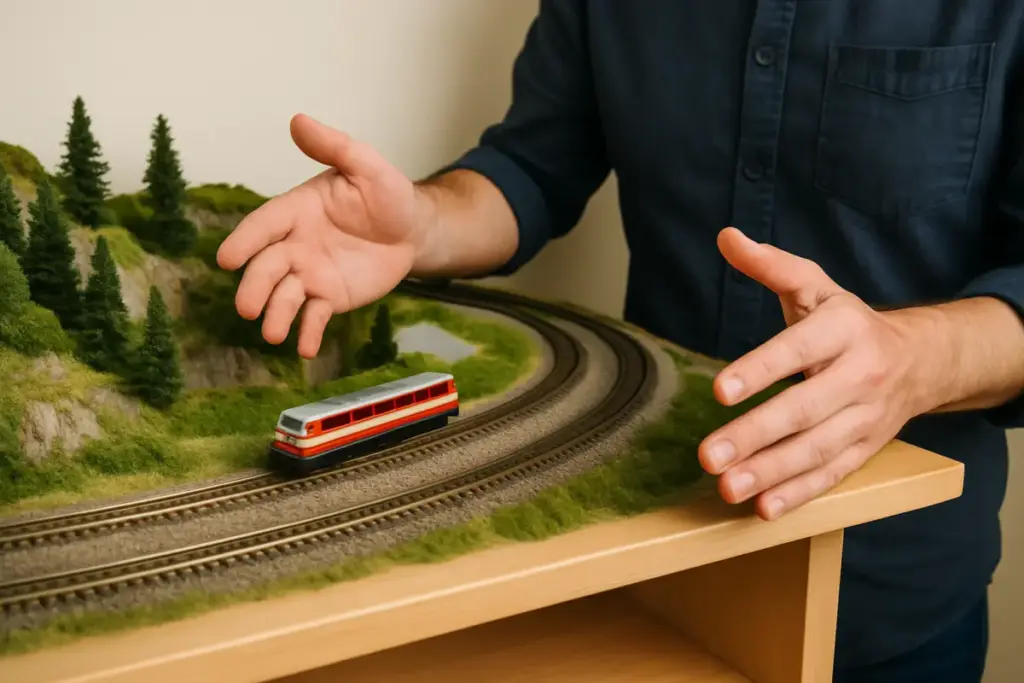
Before you cut any wood or lay track, decide what the layout is supposed to do. A good model railroad layout design starts with a purpose. Ask yourself:
– Do you want to watch trains run through scenic areas?
– Do you prefer switching industries and operating freight service?
– Do you want a specific prototype railroad or region?
– Are you building for display, operation, or both?
If you want realistic operations, design around a story. For example, a small branch line, logging route, harbor district, or industrial district can fit nicely on a shelf. If your goal is visual impact, focus on dramatic scenery, strong backdrops, and a clean track plan.
Having a purpose helps you avoid overcrowding. It’s easy to want too many features in a narrow space, but a shelf layout works best when each element has a reason for being there.
Plan the Track Before the Scenery
Good model railway layout planning begins with track planning. The track determines how trains move, where operators stand, and what kind of scenes are possible. On a shelf layout, simplicity usually wins. A layout with a few well-designed sidings, passing tracks, and switching areas often feels more realistic than one packed with complicated trackwork.
When sketching your plan, keep these design tips in mind:
– Use broad curves whenever possible for smoother running.
– Avoid tight track spacing that looks cramped.
– Include runaround tracks if you want switching operations.
– Leave enough access space for uncoupling and rerailing.
– Keep turnouts easy to reach and maintain.
It also helps to think in terms of scenes rather than one long railroad line. A shelf layout can be divided into visual “modules” such as a town, a small yard, a bridge scene, and an industry area. This creates variety and makes the layout feel larger than it is.
Choose a Track Plan That Matches Your Skill Level
For model trains for beginners, the best layout is one that is enjoyable to build and easy to maintain. A simple track plan is not a compromise—it’s a smart starting point. If you are new to the hobby, avoid designs with too many complex crossovers, hidden tracks, or hard-to-reach turnouts.
A good beginner-friendly shelf layout might include:
– A continuous loop for easy running
– A small passing siding
– One or two industries for switching
– A yard lead or storage track
– A scenic branch or endpoint for visual interest
If you want more operational challenge later, you can add structures, signals, extra sidings, or staging tracks. Starting simple reduces frustration and lets you focus on learning reliable construction and wiring.
Use Model Train Layout Ideas That Maximize Space
There are many creative model train layout ideas that work especially well on shelf designs. Since space is limited, every feature should add interest without clutter.
Here are a few effective concepts:
1. Town and Industrial District
A small town scene with a freight depot, warehouse, and local businesses can make excellent use of a narrow shelf. Add one or two switching industries to create realistic train movement.
2. Mountain or Canyon Scene
A shelf layout can look dramatic when it follows a ridge, river, or canyon wall. A curved track along a scenic backdrop can make even a short run feel impressive.
3. Harbor or Waterfront Branch
If you like industrial settings, a waterfront line with docks, freight sheds, and container areas can be visually rich and operationally fun.
4. Logging or Mining Branch
These layouts fit well on narrow shelves and offer strong scenery possibilities. Mountains, forests, and small shippers create a believable reason for a branch line.
5. Pass-Through Mainline Scene
If you enjoy continuous train movement, a shelf layout can feature a visible mainline segment that disappears into tunnels or behind scenery, giving the impression of a much larger railroad.
Think About Height, Depth, and Backdrops
A shelf layout is often only 12 to 24 inches deep, so vertical design matters. One of the most important parts of model railroad layout design is making the layout feel deep without taking up extra floor space.
A painted or printed backdrop can do a lot of visual work. It can suggest distant hills, sky, buildings, or industrial structures. Low-relief buildings and partial structures also help extend the scene without using much shelf depth.
Use height changes carefully. Small hills, road bridges, retaining walls, and elevated track sections add realism and break up the straight shelf shape. Just be sure the scenery does not block views or make derailments hard to reach.
Keep Maintenance in Mind
A great-looking layout is only successful if it runs well. During model railway layout planning, don’t forget access. Shelf layouts are often mounted at shoulder height or slightly below, which makes them easier to see but sometimes harder to repair if something goes wrong.
Design with access in mind:
– Leave enough room to reach every turnout
– Use removable scenic sections where needed
– Avoid hidden track unless necessary
– Keep wiring accessible from the front or underside
– Test all track thoroughly before finishing scenery
This practical approach is especially important for beginners. A layout that is easy to troubleshoot will stay fun to operate.
Build in Stages
You do not need to complete the whole shelf layout at once. In fact, building in stages is one of the best ways to succeed. Start with benchwork and track, then add wiring, then scenery, then buildings and details.
A staged approach is ideal if you are still learning how to start model trains. It helps you gain confidence and avoid expensive mistakes. You can also operate the layout early in the process, which makes the project more rewarding.
Final Thoughts
Shelf layouts are a perfect blend of practicality and creativity. They are compact enough for limited spaces, but flexible enough to support realistic operations and beautiful scenery. With careful planning, simple track design, and a clear purpose, you can create a layout that is both enjoyable to build and satisfying to run.
Whether you’re looking for model trains for beginners tips, a model railroad beginner guide, or fresh model train layout ideas, the shelf format is one of the best ways to begin. Focus on solid model railroad layout design, plan carefully, and let each section tell part of the story. With the right model railway layout planning, your shelf layout can become a miniature world full of motion, atmosphere, and personality.

