

 Written by
 Model Train Scales Explained
Model railroading is a hobby that blends craftsmanship, engineering, history, and storytelling. Whether you want a small shelf layout to run a single locomotive or a sprawling, realistic landscape that occupies a whole room, choosing the right scale is the first and most important decision you’ll make. This guide explains model train scales, how they relate to real-world prototypes, the practical implications of each scale, and tips for choosing the best scale for your interests and space.
What Is Scale (and Why It Matters)?
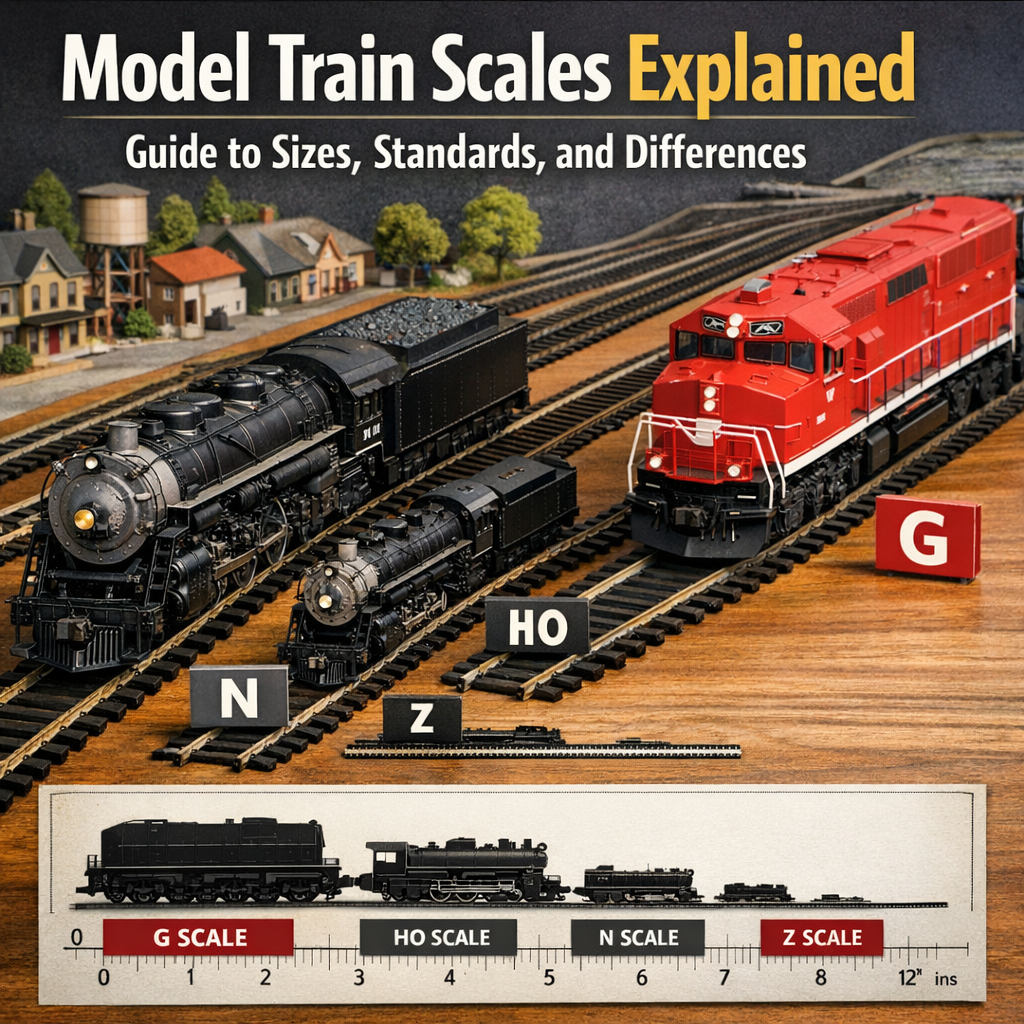
Scale is the ratio between the size of the model and the size of the real (prototype) object it represents. A model built to 1:87 scale is 1/87th the size of its real counterpart. Scale affects everything in the hobby:
- Space requirements (how large a layout will be)
- Level of detail achievable
- Cost of locomotives, rolling stock, and accessories
- Availability of products from manufacturers
- Ease of handling and construction
- Outdoor suitability (some scales are better for garden railways)
Understanding scale helps you match your goals to the practical realities of the hobby.
Scale vs. Gauge: What’s the Difference?
Gauge is the distance between the inner faces of the two rails on the track. Scale is the proportion of the model to the prototype. While these terms often align (e.g., HO scale cars on HO gauge track), they are distinct:
- Scale: Ratio (e.g., 1:160 for N scale)
- Gauge: Physical rail spacing (e.g., 16.5 mm, 9 mm)
Some modeling approaches use narrow-gauge prototypes on a standard gauge track representation (e.g., O-16.5 uses O scale rolling stock on HO track gauge to represent narrow gauge prototypes).
Common Scales and Ratios
Here are the most widely used scales, from smallest to largest, including typical use-cases and basic pros and cons.
Z Scale (1:220)
- Track gauge: 6.5 mm
- Typical use: Very small layouts, multi-level shelves, limited space
- Pros: Smallest commonly available scale; great for large scenes in tiny spaces
- Cons: Tiny parts are fragile and hard to detail; less variety in availability; electronics can be challenging
N Scale (1:160)
- Track gauge: 9 mm
- Typical use: Space-efficient layouts, continuous-run railroads, multi-level staging
- Pros: Good balance between size and detail; large selection of items; ideal for people with limited space
- Cons: Small details harder to work with than HO; some types of weathering and scratch-building are more difficult
TT Scale (1:120)
- Track gauge: 12 mm (not as common in the U.S.; popular in Europe)
- Typical use: Middle ground between N and HO
- Pros: More detail than N while still compact
- Cons: Fewer manufacturers and less support than more popular scales
HO Scale (1:87)
- Track gauge: 16.5 mm
- Typical use: Most popular worldwide; highly varied layouts from small to large
- Pros: Extensive product availability; balance of detail and manageable size; affordable
- Cons: Requires more space than N or Z; large layouts can still be expensive
S Scale (1:64)
- Track gauge: 22.48 mm
- Typical use: Classic American modeling; used for some detailed freight and passenger modeling
- Pros: Better detail and sturdier parts than HO; good compromise between HO and O
- Cons: Less common than HO or O; limited product ranges
O Scale (1:48 in U.S., 1:43.5 in the UK)
- Track gauge: 32 mm (standard O gauge)
- Typical use: Toy trains, display models, detailed modeling
- Pros: Large enough for impressive detail; great for showcasing fine craftsmanship
- Cons: Requires substantial space; often more expensive; older toy-style couplers and track standards can be limiting
G Scale (Garden Scale) (1:22.5 – 1:32 depending on prototype)
- Track gauge: 45 mm (common)
- Typical use: Garden railways and outdoor layouts
- Pros: Weatherproof options; robust and easy to handle outside; impressive presence
- Cons: Large size and weight; expensive; not suitable for indoor small layouts
Other Scales and Narrow-Gauge Variants
- O-16.5 (O scale models running on 16.5 mm HO track to represent narrow gauge)
- HOn3 (HO scale running on 10.5 mm track to represent 3-foot narrow-gauge prototypes)
- Sn3, On30, etc.: Scales and combinations representing narrow-gauge prototypes using various gauges
Scale Examples: What Do They Look Like in Real Life?
- 1:160 (N): A passenger coach is roughly 18–22 cm long; a small layout can fit in a medium-sized coffee table.
- 1:87 (HO): The same coach is approximately 34–36 cm long; a layout with realistic running room might start at 2m x 1m.
- 1:48 (O): That coach becomes a full meter long — great for display but requires serious layout space.
These examples show how quickly required space grows as scale increases.
Space Planning: Layout Size and Scale
Choosing a scale often comes down to available space. Here are some illustrative layout footprints and what they can support:
- 2 ft x 4 ft (60 x 120 cm)
- Z or N: Small switching layout or switcher coffee-table layout with several yards
- HO: A point-to-point micro layout (limited)
- O/G: Not feasible
- 4 ft x 8 ft (120 x 240 cm)
- N: A very good continuous-loop, multiple towns, multi-level layout
- HO: Classic starter layout with decent yard and mainline
- O: Could support a small terminus or simple loop but will feel cramped
- 6 ft x 12 ft (180 x 365 cm)
- HO: Excellent for detailed mainline with multiple yards and scenery
- O: Room for a good-sized O layout with detailed operations
- Garden space (patio or backyard)
- G scale: Large, realistic garden railway with weatherproof equipment
When planning, always allow for access aisles, electronics, and staging hidden tracks. Larger scales amplify every operational and scenic detail, but also exponentially increase cost and storage needs.
Detailing and Realism by Scale
Smaller scales (Z, N) require more delicate tools and may limit weathering and scratch-building. HO and larger scales provide:
- Greater ability to model fine detail (handrails, brake lines)
- Easier installation of sound and lighting equipment
- More realistic-weight rolling stock for better traction and performance
However, detail is also influenced by manufacturer quality and aftermarket parts. Modern N scale models can be extremely detailed, and many modellers use photo-etch, 3D-printed parts, and custom painting to elevate realism.
Track Standards, Wheel Standards, and Couplers
All scales have standards regulated by organizations (NMRA in North America, NEM in Europe, etc.) to ensure interoperability.
- Track: Code numbers indicate rail height (e.g., HO code 100, code 83). Finer-scale modeling uses lower codes to imitate prototype rails.
- Wheels: Flange depth and back-to-back wheel spacing must match track gauge and turnout geometry.
- Couplers: Varies per scale. HO and larger scales often use knuckle couplers (Kadee-style), S and O have their own types, and N and Z have tiny, specialized couplers. Many enthusiasts swap couplers for operational realism and reliability.
Always ensure rolling stock and track adhere to the same standards for reliable operation.
Power and Control: DC, DCC, and Beyond
Two primary control systems dominate model railroading:
- Analog DC (Direct Current): Voltage on the rails controls speed and direction of locomotives. Simple and inexpensive but limited for multi-train independent control.
- DCC (Digital Command Control): Digital signals on the rails allow individual control of multiple locomotives, accessories, lighting, and sound. DCC decoders are installed inside locomotives.
Scale influences the ease of installing decoders and speakers:
- Larger scales: Room for full-featured decoders and realistic sound systems.
- Smaller scales: Smaller decoders exist but speaker size limits bass and volume; installation can be challenging in Z and small N locos.
Other systems:
- Battery power and radio control (DCC-like operation without track power), popular in G and garden scales and increasingly used indoors to avoid wiring complexity.
Cost Considerations by Scale
Generally:
- Smaller scales (N, Z): Lower per-item cost for rolling stock but require more material for track and scenery per area because you’ll build larger, more compressed layouts.
- Larger scales (HO, O, G): Higher individual item costs, but less track length per modeled mile of prototype. G and large O can be very expensive due to build materials and weatherproofing.
Budgeting tip: Factor in not just rolling stock costs but track, turnouts, power systems, scenery supplies, tools, and storage.
Hobby Support and Product Availability
- HO: Widest selection of locomotives, rolling stock, structures, and aftermarket detail parts. Great for beginners and advanced modelers alike.
- N: Very strong product support, especially from manufacturers focused on space-saving layouts.
- O: Good selection, with many high-detail models, especially in the U.S. and Germany.
- Z and TT: More niche; manufacturers produce popular prototypes but fewer options.
- G: Strong for garden-scale manufacturers; niche but dedicated market.
Check manufacturer catalogs and hobby shops for prototype-specific availability. Some prototypes are better represented in certain scales (e.g., European narrow gauge often favored in H0e/TT).
Weathering, Scenery, and Detailing Tips by Scale
- Tools: Use fine brushes, airbrushes, and magnification for N and Z; standard tools work well for HO and above.
- Scenery: Fine turf and static grass in small scale should be micro-sized; coarse materials look unrealistic in N/Z.
- Weathering: Washes, powders, and subtle chipping look better than heavy-handed techniques, especially in larger scales where defects are more visible.
- Scratch-building: Larger scales make scratch-building easier; in small scales, use laser-cut kits or 3D printed parts.
Maintenance and Operational Reliability
- Track cleaning and wheel maintenance are universal tasks.
- Small scales require more careful cleaning due to tighter electrical tolerances.
- Turnouts and complex trackwork require precise alignment — critical in scales with small flanges.
- Storage: Larger locomotives and cars need more space and proper climate control for long-term preservation.
Choosing a Scale: Questions to Ask Yourself
- How much space do I have?
- Tiny apartment: N or Z
- Spare bedroom: HO or N
- Basement or garage: HO, O, or G depending on size
- What is my budget?
- Lower budget + want scenic detail: N (materials scaled down but cost per unit lower)
- Higher budget + want detail and hands-on: HO or O
- Do I value operations (running trains) or display and modeling detail?
- Operations: N and HO both good; N allows longer runs in less space
- Display/detail: O and larger scales excel
- Do I want to model a specific prototype?
- Research availability in different scales (e.g., British prototypes are often available in OO rather than HO)
- Do I prefer indoor or outdoor layouts?
- Outdoor: G scale
- Indoor: Almost any scale, but consider room climate
Examples: Choosing a Scale for Different Goals
-
Small Apartment Commuter
- Goal: Realistic passenger operations, multi-train running
- Scale: N
- Layout: 4 ft x 8 ft shelf layout with staging and a town module
- Compromises: Small detail; DCC decoder installation can be fiddly
-
Family Hobby in a Spare Bedroom
- Goal: Mix of operations and scenery, accessible for children
- Scale: HO
- Layout: 9 ft x 12 ft L-shaped with yard, small industries, and scenic backdrop
- Benefits: Wide product availability; easy to find clubs and advice
-
Backyard Enthusiast
- Goal: Rugged layout that withstands weather and looks impressive outdoors
- Scale: G
- Layout: Multi-loop garden with realistic rockwork and live plants
- Considerations: Use weatherproof electronics and avoid corrosive materials
-
Museum Display or High-Detail Showpiece
- Goal: Large, highly detailed scenes with static models and animation
- Scale: O
- Layout: Large continuous-run display with scratch-built buildings and animated details
- Advantage: Stunning realism; excellent for public exhibits
Compatibility and Conversions
- Coupler swaps and wheelset changes can make rolling stock compatible across different manufacturers in the same scale.
- Narrow-gauge modeling often uses alternate gauges (e.g., HO scale on 9 mm track to represent metre-gauge prototypes known as H0m).
- If converting older models or mixing brands, check flange depth, wheel back-to-back, and coupler height to avoid derailments.
Joining a Community and Learning More
- Local clubs: Great for trying different scales and learning layout-building techniques.
- Online forums and social media: Rich resources for troubleshooting, kit bashing, weathering, and electronics.
- Manufacturer support: Many companies offer technical sheets and manuals for scale-specific standards.
- NMRA/NEM: Standards organizations publish scale and gauge guidelines and offer clinics and events.
Advanced Topics (Brief)
- Fine-scale standards: These aim for more accurate wheel and track profiles for maximum realism (e.g., finescale standards in HO).
- 3D printing and laser cutting: Increasingly important for producing unique parts at every scale.
- Sound and DCC: Multi-function decoders enable prototypical whistles, bells, and consist control even in smaller scales.
- Automation and signaling: Block detection, computer control, and signaling add operational depth and challenge.
Quick Reference Table of Common Scales (Summary)
- Z — 1:220 — Smallest common scale
- N — 1:160 — Space-efficient; great product selection
- TT — 1:120 — Less common; middle ground
- HO — 1:87 — Most popular; best balance of size, cost, and detail
- S — 1:64 — Niche; good detail
- O — 1:48 (US) — Large; excellent detail and presence
- G — 1:22.5–1:32 — Garden/outdoor modeling; rugged and large
Practical Tips for Getting Started
- Visit a local hobby shop or club to see scales in person before committing.
- Start with a small project or module that fits your space and budget. Expand as your skills grow.
- Buy quality track and turnouts—poor track causes frustration early on.
- Consider DCC from the start if you want multiple independent trains.
- Keep a notebook of dimensions and standards for your chosen scale: coupling height, rail code, wheel profiles.
- Use scale-specific scenic materials; what looks right in HO won’t look right in N or Z.
- Practice soldering and wiring on old locomotives before modifying new ones.
Common Pitfalls to Avoid
- Choosing a scale only based on price—consider long-term satisfaction and availability.
- Underestimating space: Always sketch your layout and allow for access.
- Mixing incompatible standards without checking dimensions (couplers, pocket sizes, wheel back-to-back).
- Buying too many items at once—start with a loco and a few cars, learn what matters most to you.
Conclusion
Choosing a model train scale is a balance among available space, budget, desired level of detail, and the specific prototypes you want to model. HO scale remains the most popular and versatile, N scale offers remarkable space efficiency, Z scale is perfect for tiny layouts, and G scale rules the outdoors. Each scale brings its own set of trade-offs in terms of cost, handling, and modeling techniques. Visit clubs, talk to hobbyists, and test-run models at local stores to make an informed choice. Once you’ve picked a scale, the world of track plans, detailing, weathering, and operations awaits—each layout an opportunity to tell stories and celebrate the magic of railroading in miniature.