


 Written by
 HO Scale vs N Scale: Which One Is Right for Your Model Railroad?
Choosing a scale is one of the first and most important decisions a model railroader makes. It affects everything from space requirements and cost to the level of detail you can achieve and how the finished layout will look in a room. HO and N scales are two of the most popular scales among hobbyists. This article compares them side-by-side to help you decide which best matches your goals, budget, and available space.
We’ll cover the practical differences, pros and cons, layout ideas, operational considerations, and a checklist to guide your decision.
Quick overview: What are HO and N scales?
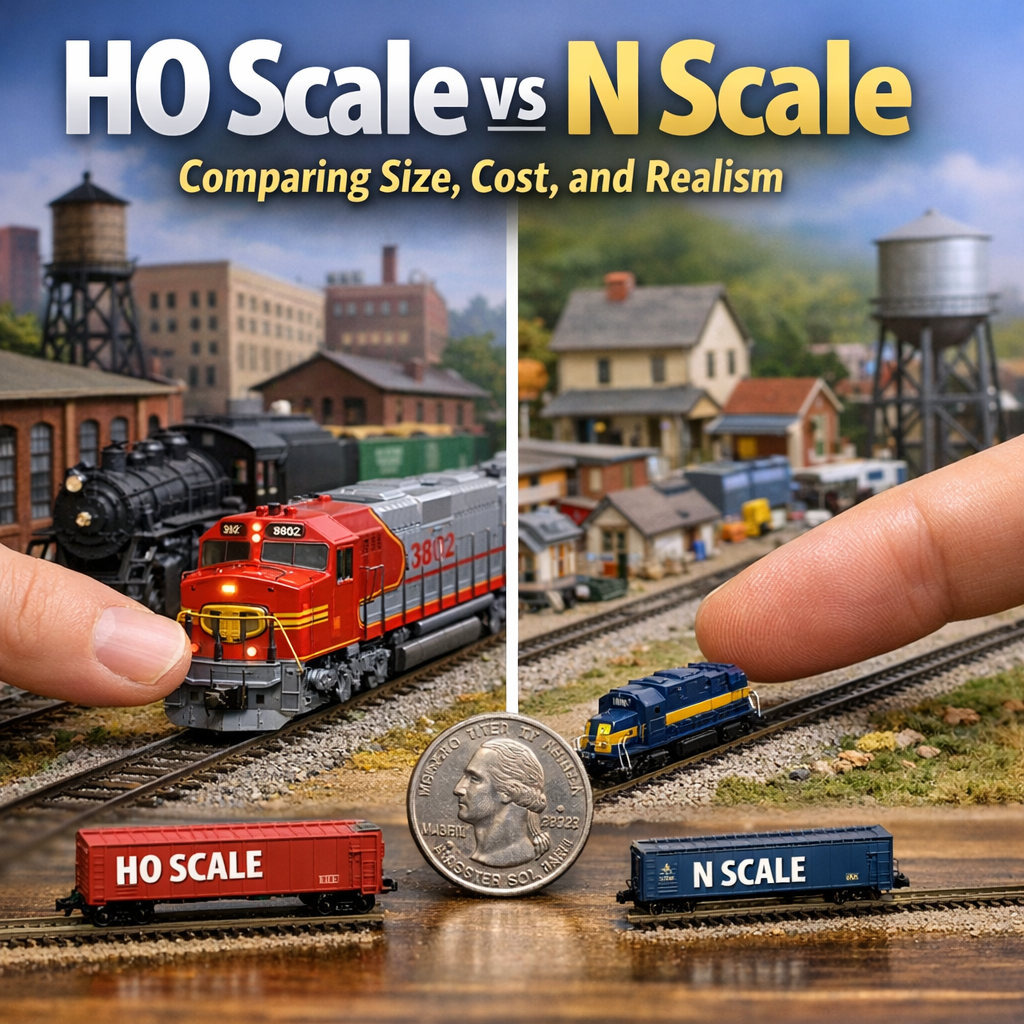
- HO scale: 1:87 (often written 1:87.1). HO is the most popular model railroad scale worldwide. Track gauge for standard gauge prototypes is 16.5 mm.
- N scale: 1:160 (commonly 1:160 for most manufacturers). N is roughly half the size of HO and is valued when space is limited or when modelers want long mainlines in a modest footprint. Track gauge for standard gauge prototypes is 9 mm.
In practical terms, an average 50-foot freight car measures about 6.9 inches long in HO and about 3.75 inches long in N. That size difference drives many of the trade-offs discussed below.
Visual differences and realism
- Detail level: HO models are larger, so manufacturers can include more fine detail and working features (e.g., delicate grab irons, etched details, and larger motors). N-scale models have impressive detail for their size, but extremely small parts are harder to add and may be more fragile.
- Visual scale effect: Because N scale is smaller, you can fit more railroad into the same room. That can yield more convincing long-distance vistas, longer mainlines, and complex track arrangements that better mimic real railroads. HO models typically look more convincing up close and photograph more easily without specialized macro techniques.
- Eye perception: At normal viewing distances, N scale can give a better “sense of distance” since you can compress more terrain into the space. HO conveys material realism when you’re working close to the model because the parts and textures are physically larger.
Example: If you want a continuous 40-foot mainline loop, in HO you might need a fairly large room or clever benchwork; in N scale you can achieve a similar visual effect in about half the space while still including towns, yards, and scenery.
Space and layout planning
Space is often the deciding factor.
- Benchwork depth:
- HO: 24–30 inches is common for walk-around layouts; 18–24 inches at minimum for shelf-style layouts.
- N: 12–18 inches for shelf-style layouts; 24 inches or more for more expansive scenes.
- Typical layout footprints:
- Small HO: 4×8 feet (classic starter size) — good for a switching layout or a simple peninsula.
- Small N: 2×4 or 2×8 feet can support surprisingly complex trackwork; bookshelf or shelf layouts of 8–12 inches deep are practical.
- Multi-deck layouts:
- N scale is much easier for multi-deck or helix-based layouts because the vertical and horizontal space savings allow more layers without huge room height.
- Modules and portability:
- If you plan to join a modular club or participate in shows, check local club standards. NTRAK (popular for N) and Free-mo (for different scales) have specific module dimensions. N modules are generally lighter and easier to transport.
Practical example: In a spare bedroom, a 12×8 foot area might allow a large, realistic N-scale layout with long runs and varied scenery; achieving the same visual complexity in HO would likely require more room or multi-level benchwork.
Cost comparison
Costs vary widely, but there are general tendencies:
- Entry-level:
- Both scales offer starter sets (analog or DCC-ready). Starter sets for HO and N are typically in the $200–$500 range, depending on manufacturer and included features (locomotive, cars, controller, track pieces).
- Rolling stock and locomotives:
- HO locomotives with motors and sound decoders can range from around $100 for basic units to $500+ for high-end, detailed, sound-equipped models.
- N locomotives are comparable in retail price for similar levels of detail and sound, but high-end N models and decoders can cost a bit more due to increased engineering and miniaturization.
- Track and accessories:
- Track and turnouts in N scale are smaller but often cost slightly less per foot than their HO counterparts; however, the difference is modest.
- Scenery and structures:
- Buildings and scenery supplies are generally less expensive in N simply because the raw material per structure is lower. But detailed loaded structures with interiors often cost similar relative to scale.
- Electronics:
- DCC decoders for N must be smaller; high-quality sound decoders can be pricier or require careful selection to fit. HO often has more space for decoders, larger speakers, and higher-sound quality options.
- Overall: while N can be slightly less expensive in terms of scenery materials and track length needed, costs for locomotives and rolling stock are comparable. Expect to spend similar total amounts for comparable levels of operation and detail, with savings in N mainly coming from reduced scenery materials and construction time.
Note: Prices vary by brand, era, and region. Always research current market prices and local availability.
Handling, construction, and maintenance
- Ease of handling:
- HO: larger parts are easier to hold, glue, paint, and modify. Replacement parts and details are easier to fabricate or source.
- N: requires finer motor skills for assembly and detail work; small parts are fragile and easier to lose.
- Track-laying:
- HO track-laying often uses thicker roadbed and more forgiving tolerances. N requires more precise alignment because small errors scale down and become major operational issues.
- Wiring:
- Both scales benefit from multiple feeders and a good power bus. N scale wire is thinner and connections are smaller, which can make soldering and troubleshooting slightly more finicky.
- Maintenance:
- Wheel cleaning, track cleaning, and turnout adjustments matter in both scales. N can be more sensitive to dirty rails and small debris due to smaller electrical contact areas.
Practical tip: Beginners who are comfortable with fine-detail work (e.g., modeling miniatures) may find N manageable. Those who prefer less fiddly assembly often gravitate to HO.
Operations and electronics (DCC, sound, automation)
- DCC:
- Both scales are well-supported by DCC systems. HO has a long history of DCC usage and a wide array of decoder options, sometimes with more features available for the space. N decoders have advanced substantially and now offer sound and advanced functions in small packages.
- Sound:
- HO offers easier placement of speakers and often superior sound fidelity due to larger speaker sizes. Small N-scale speakers and sound decoders have improved dramatically, but compact locomotives still face constraints in speaker size and placement.
- Automation:
- N benefits from being able to put longer mainlines and complex circuits into smaller footprints, enabling realistic timetable operations and longer running sessions in compact spaces.
- Wiring complexity:
- Intricate yards, reversing loops, and block detection add complexity in both scales. N’s smaller wires and clearance can make wiring slightly more challenging but not prohibitive.
Example: A club layout that models a regional railroad with long mainline runs might choose N for its ability to provide realistic long-distance operation in limited space, while another group focusing on detailed switching might opt for HO.
Scenery, landscaping, and realism techniques
- Terrain sculpting:
- Techniques (foam, plaster, Sculptamold, resin) are the same across scales. The scale determines how textures and vegetation are represented.
- Ground textures:
- In HO, rock molds, ballast, and ground foam can be used at larger sizes; in N scale you use finer ballast and ground foam to maintain scale appearance.
- Structures:
- HO structures are larger and easier to detail with interiors and lighting. N structures offer a big advantage where you want to show multiple towns, industries, and buildings in a compressed area.
- Perspective tricks:
- Forced perspective (smaller buildings in background) works well with both scales, but it’s easier to incorporate varied perspective in N because of the space savings.
Example: If you want a 1:1 representation of a mountain range with layered scenery and a long winding mainline, N gives you the space to make that scene feel expansive at home.
Availability and variety of models
- Manufacturers:
- HO has vast offerings from Atlas, Athearn, Bachmann, Walthers, Kato, and many specialized builders.
- N also has excellent options from Kato, Micro-Trains, Bachmann, Atlas, and several boutique manufacturers.
- Prototype variety:
- Both scales cover steam, diesel, and modern era prototypes across continents. HO typically has the widest selection overall simply because of its popularity, but N is very well-served too.
- Aftermarket and detailing:
- HO benefits from a large aftermarket for detail parts, photo-etch, wheelsets, couplers, and conversion kits. N aftermarket is robust but sometimes requires more specialized parts.
Community, clubs, and standards
- Clubs and modular standards:
- NTRAK is a widely used modular standard for N scale that enables clubs to assemble large layouts quickly. Free-mo, Free-mo-NT, and other standards exist for both HO and N.
- Events and shows:
- Both HO and N are commonly represented at local and national shows. HO’s larger market share means more HO-centric events, but N enjoys strong representation at modular meets.
- Learning resources:
- Tutorials, forums, and books exist for both scales. Many techniques are transferable.
Pros and cons at a glance
HO Scale
- Pros:
- Easier to handle and detail.
- Wide availability of models and parts.
- Better sound options and interior detail potential.
- Easier mechanical and electrical work for beginners.
- Cons:
- Requires more space for expansive mainlines.
- Larger structures and scenery take more materials and room.
N Scale
- Pros:
- Excellent space efficiency — you can fit a lot of railroad into limited space.
- Great for multi-deck and long-run layouts.
- Can produce very impressive “railroad in the room” scenes with relatively small footprints.
- Cons:
- Smaller parts are fiddlier to assemble and maintain.
- Some electronics (speakers, decoders) require careful selection and installation.
- Slightly less forgiving to track alignment and dirty rails.
Choosing the right scale — questions to ask yourself
Use this checklist to decide which scale fits you:
- How much space do I have?
- Small room, bookshelf, or limited wall space → consider N.
- Dedicated hobby room or garage → HO is very practical.
- What are my primary goals?
- Detailed scratchbuilt structures and close-up realism → HO.
- Long mainlines, more scenes, multi-deck layouts → N.
- What’s my budget?
- Both scales can be budget-friendly or expensive; evaluate initial layout vs long-term expenses.
- How comfortable am I with small parts and fine soldering?
- If you dislike fiddly work, HO may be easier.
- Do I want to operate with long trains and prototypical runs?
- N can provide longer runs in less space, making it attractive for operational modelers who cannot dedicate a large room.
- Do I plan to join a modular club?
- Check local clubs and standards — that could influence scale choice.
Layout ideas by scale
- HO ideas:
- 4×8 switching layout: industries, small yard, and some scenic elements.
- Point-to-point branchline: a small scenic town connected to a main yard for realistic switching ops.
- Urban freight terminal: detailed structures, vehicles, and street scenes.
- N ideas:
- Shelf layout with a continuous mainline and scenes spaced along the shelf.
- Multi-deck “mountain” layout: helix or grades connecting levels to create long runs.
- Modular NTRAK-style exhibition layout: build small modules that join together at shows.
Getting started: practical steps
- Define space: measure the room and create a footprint.
- Pick a prototype or theme: era, region, and operational focus.
- Choose a track plan: plenty of plans exist tailored to scale and space.
- Budget a starter set and a few additional locomotives/cars.
- Learn basic wiring and DCC concepts (if relevant).
- Start with a small test area or diorama to practice scenery and weathering.
- Join local clubs or online forums for advice and support.
Conclusion
HO and N scales each have strong merits. HO is forgiving, accessible, and ideal if you prefer larger detail work, easier electronics, and abundant aftermarket support. N excels where space is limited or when you want long, prototypical mainlines and multiple scenes within a modest footprint. Both scales support excellent operation, scenery, and community involvement.
Choose the scale that best aligns with your room size, modeling goals, and the type of experience you want — whether that’s the tactile detail of HO or the grand, space-efficient vistas possible in N. Either way, you’ll be joining a vibrant hobby with plenty of resources, clubs, and fellow modelers to help you learn and grow. Happy modeling!